 +
+
A useful TikTok creator brief is not a miniature commercial. It is a short agreement about the customer problem the video must make clear, the proof the creator needs to show, and the few things that cannot be misstated. For brand managers who keep getting polished videos that do not move a product decision forward, that distinction matters. This article gives you a TikTok creator brief template you can use before a campaign starts, plus a way to review it without turning every creator into the same spokesperson.
The direct answer is simple: brief the evidence and the outcome, not every line of dialogue. By the end, you will have a one-page brief that protects accuracy, gives the creator a real job to do, and makes the finished footage easier to compare across a campaign.
Think of the brief as a clear handoff. The brand says what must be true. The creator decides how to make it feel real. The viewer gets a useful answer, not a long claim. That split makes the job less tense for all three people. It also gives the team a fair way to judge the post after it goes live.
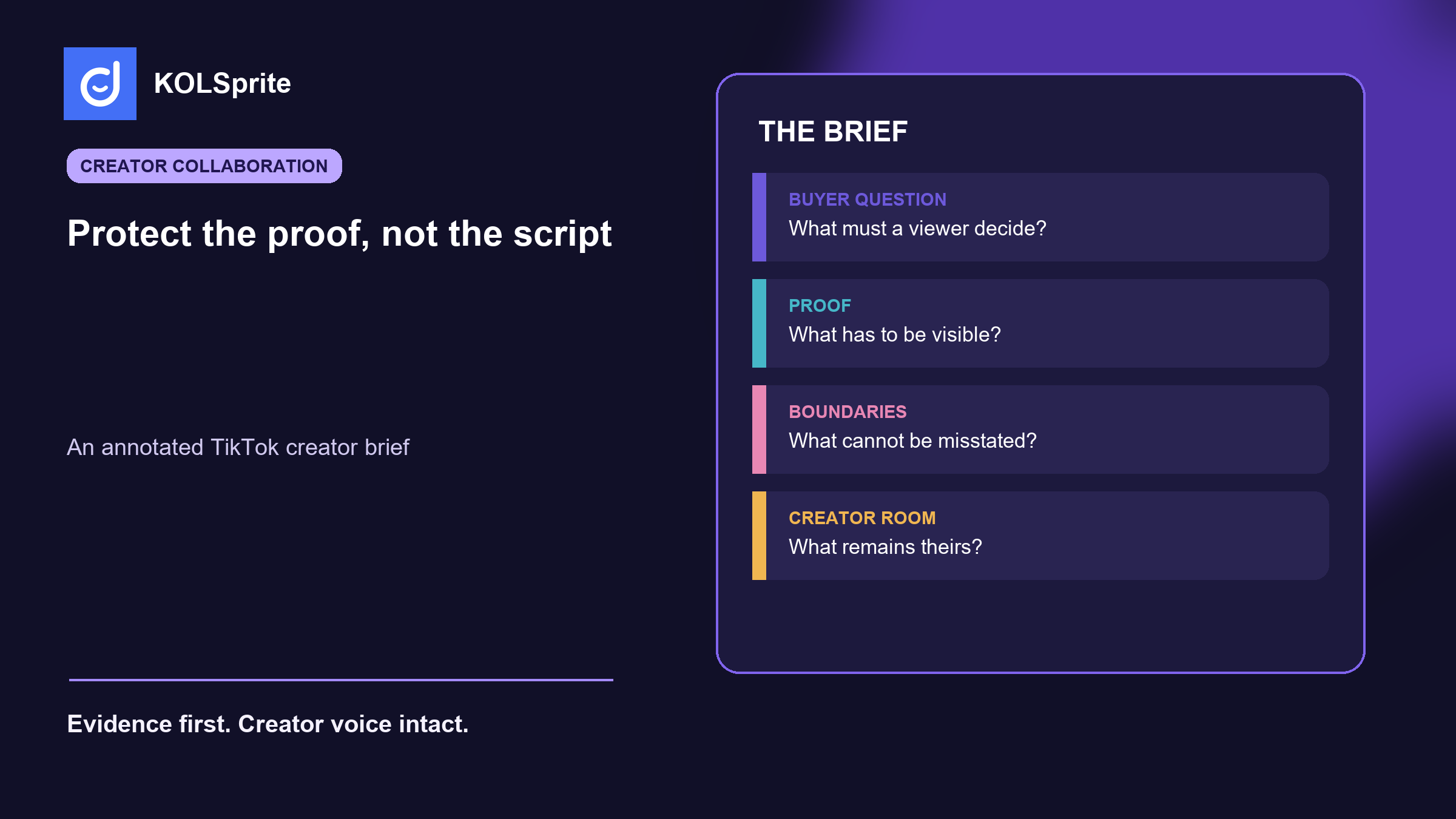
Start with one buyer question. State the proof that can answer it. Name the limits, deliverables, and approval checkpoints. Then leave the hook, wording, and personal examples to the creator unless a claim, price, or legal disclosure requires exact language.
Many briefs begin with internal comfort: a long product description, a list of features, and a mandatory slogan. That can make a team feel covered, yet it gives the creator no usable point of view. The result often opens with a broad promise, runs through every feature, and ends with a call to action that could belong to any product.
A creator sees the viewer's hesitation before the brand does. They know which use case feels ordinary, which detail invites a comment, and which comparison will sound forced. Your brief should preserve that advantage. It should tell them what must be true, not pretend the brand can write a better native TikTok than the person who built an audience there.
That does not mean "do whatever you want." A good brief is more demanding than a script because it asks for a credible demonstration. It says what question the video needs to settle and what a reasonable viewer must be able to see or hear before they believe the answer.
Use this as a working document, not a form to pad. If a field does not change the creator's decision, remove it.
| Brief field | What to write | What it prevents |
|---|---|---|
| Viewer and moment | "People packing lunch before an early commute" rather than "our target audience." | A generic opening with no situation. |
| Buyer question | One question the video should help a viewer answer, such as "Will this stay cold until noon?" | Feature lists without a reason to care. |
| Proof to capture | The visible or audible evidence: setup, side-by-side test, measurement, or ordinary use. | Claims that cannot be understood from the video. |
| Non-negotiables | Accurate product name, approved claim boundaries, disclosure, timing, and any safety limits. | Late compliance or factual rework. |
| Creator freedom | Hook, setting, phrasing, supporting example, and editing rhythm. | A staged, copied-and-pasted ad. |
| Decision signal | The response you will examine: repeated question, save behavior, qualified comments, or a clear objection. | Judging only by a top-line view count. |
Scope: This is a planning template, not a prediction of reach or sales. Keep product, price, and disclosure language current for the market where the content appears.
"Back-to-school content" is a theme. "Can this backpack fit a laptop, lunch, and a change of clothes without looking bulky?" is a buyer question. The second one gives a creator something to prove. It also gives the team a way to judge the video later: did viewers understand the fit, and did they raise a different concern?
The question should be narrow enough to show in one piece of content. It should not be "Why is our product better?" It should be a question a person could ask while scrolling, comparing, or deciding whether to click into a product page.
Before you send the brief, read that question aloud. If it sounds like a slide heading, rewrite it in customer language. If you have public TikTok comments, creator captions, or search phrasing that describe the same hesitation, use those words. They will give the creator a more natural entry point than brand terminology.
Use KOLSprite to research supported public creator and content context before you decide who can make the product proof your brief requires.
Register and claim a three-day trial
"Show the quality" is not a direction. "Show the zipper after packing a full day bag, then hold the bag beside a standard backpack" is a direction. The goal is not to choreograph every second. It is to say what evidence the viewer needs.
There are four common proof types:
A constraint can make the content more trustworthy. A creator does not need to say a product fits everyone if the product clearly works for a particular routine. The brand's job is to give the creator accurate boundaries early so that the story remains useful instead of overly careful.
Creators do more than supply reach. One may make a technical comparison understandable. Another may show a real routine. A third may be good at inviting informed questions in comments. Those are different contributions, and a brief should match the contribution you need.
KOLSprite can help a team examine public creator pages and public videos while browsing TikTok, then save the examples that make a specific style of proof work. For this use, the output is not "the best creator" score. It is a small evidence set: a few public posts, a repeatable format, the audience language around them, and notes about whether the creator can make the required proof visible.
That changes the review conversation. Instead of saying "this person has good engagement," you can ask, "Have they already explained a product choice in a way that lets a viewer judge it?" The second question is closer to the job you are hiring them to do.
It also gives you a fairer way to compare creators. Do not rank a creator only by the size of one recent post. Compare the public evidence against the proof your brief needs: Can the person show the setup clearly? Do they make trade-offs understandable? Does their normal format leave room for a disclosure without hiding it? Those questions do not guarantee an outcome, but they make the selection decision easier to explain.
Join the KOLSprite Discord to compare creator-proof ideas, brief boundaries, and ways to preserve a creator's real voice.
 +
+
Join the KOLSprite Discord community
Put the fixed items in one short section. These usually include the product name, a current offer if one is required, a disclosure requirement, prohibited claims, and approval timing. The Federal Trade Commission's influencer guidance emphasizes that material connections should be clear and hard to miss; your disclosure instruction should be explicit and should fit the creator's platform format. See the FTC's Disclosures 101 for Social Media Influencers for its current guidance.
Everything else should be a choice when possible. Let the creator choose a setting that belongs to their audience. Let them decide how to phrase the tension. Let them choose the first visual, provided it does not change the claim. A creator who can make these choices will usually give you a more believable first five seconds than a brand-written line ever could.
The cheapest revision is the one you make before filming. Run this five-question check with the person approving the campaign:
If the answer to the last question is no, the brief is not ready. You may need a different proof approach, a different creator, or less brand language.
After publication, do not reduce the result to a reach report. Capture the recurring questions, the parts viewers repeated back, and the objections that remained. A post can have modest distribution and still teach you that the proof was unclear, the price needs context, or one use case is more compelling than the one you chose.
In KOLSprite, a team can keep public examples and creator notes together while it researches the next angle. That makes the next brief more specific without making it more rigid. It also prevents a common problem: treating every new creator as though the team has learned nothing from the last one.
For the commercial conversation that follows the brief, use the work-based creator pricing range rather than a follower-count shortcut. The creator fit questions can guide public research before the brief, and the outreach evidence template can keep the first message tied to a real reason for contact.
The best TikTok creator brief template does not try to predict a viral result. It makes one content decision testable. It gives a creator enough clarity to show real proof and gives your team enough structure to see what changed after the post.
Keep the document short. Protect the facts. Ask for evidence a viewer can recognize. Then let the creator bring the voice, the setting, and the human detail that made their audience follow them in the first place.
Latest Articles
As an essential, data-driven toolkit for TikTok influencers and marketers, KOLSprite provides powerful features for effortless creator discovery, trending content identification, and actionable real-time insights.
It empowers users to make smarter decisions and significantly boosts their TikTok business.
 Refer & Earn