 +
+
Before a paid or gifted-product TikTok post is approved, a team should be able to answer a basic question: will an ordinary viewer understand the creator's link to the brand and the product claim being made? A clear sponsorship note audit is not a legal memo and it is not a search for perfect wording. It is a short review that records the brand link, where the clear sponsorship note appears, whether it is clear, and which claim needs another owner. This guide gives partnership teams a usable clear sponsorship note Review Note.
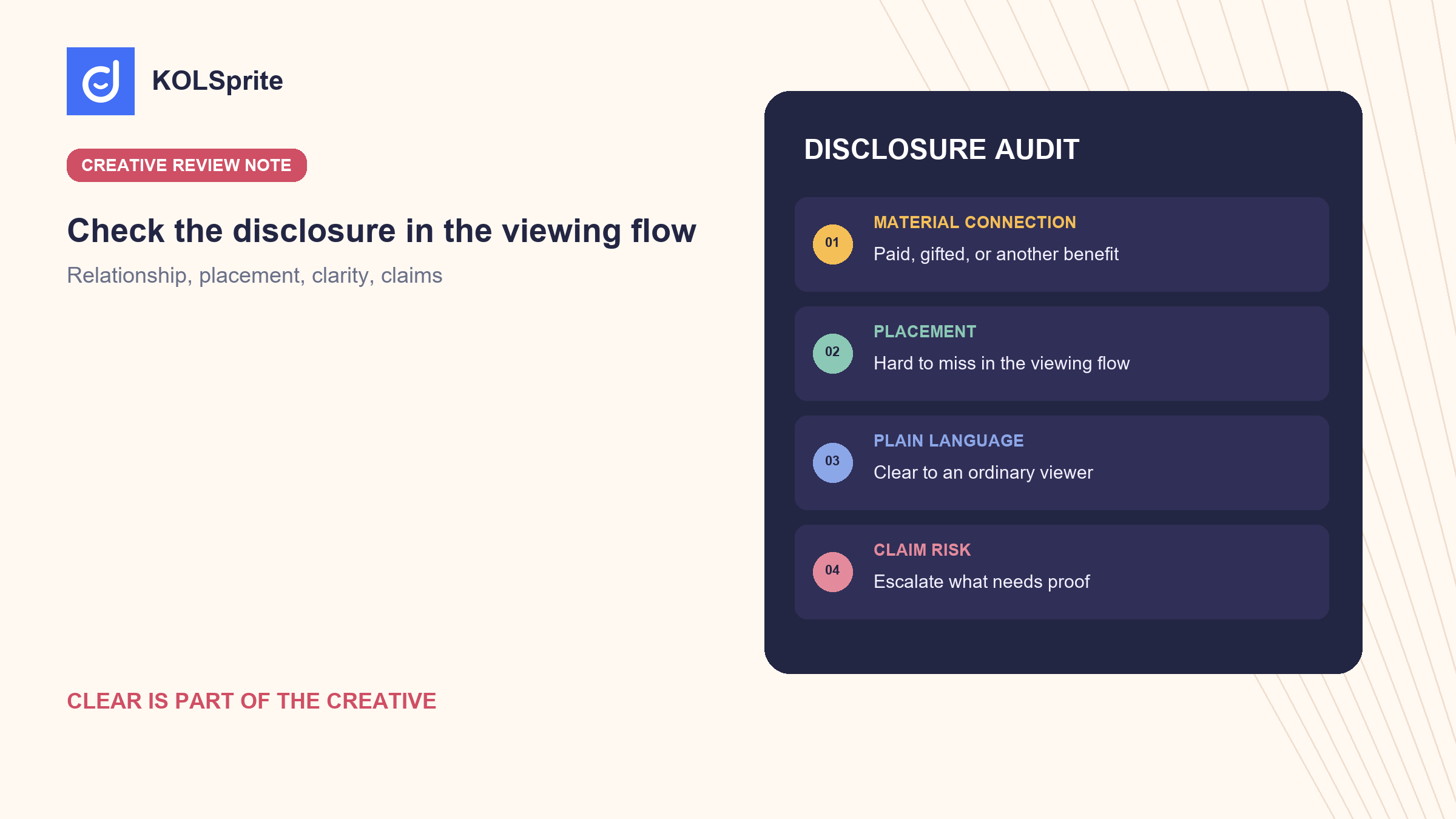
Ten-second answer: Check the relationship, placement, clarity, and claim context together. If the disclosure can be missed, the relationship is not clear, or the product claim lacks support, pause approval and send a specific question back to the right owner.
Many teams treat clear sponsorship note as something to add after the concept is approved. That creates avoidable tension. Placement and clarity are part of what a viewer sees. So they should be reviewed with the opening, the product demo, and the spoken claim. If the creative depends on a quick reveal, the clear sponsorship note needs to work in that viewing pattern instead of being quietly appended to the caption.
The FTC's plain-language guidance says that people should be able to see and understand a brand link. A connection can include payment, free or discounted products, employment, or another thing of value. The agency also warns that clear sponsorship notes buried in a profile, at the end of a post, or mixed into hashtags or links are likely to be missed. That is why an audit begins with the viewer's screen, not the contract folder.
Source: FTC: Disclosures 101 for Social Media Influencers. Scope: This article summarizes public U.S. guidance and is not legal advice.
Start at the first seconds of the video. What is the endorsement? When does the product appear? Where is the link explained? Is the language plain enough to be understood without industry knowledge? Then look at the caption and any platform clear sponsorship note tool as extra context, not as a substitute for a clear message in the content where the endorsement occurs.
A useful review note avoids vague comments such as “add clear sponsorship note.” Instead, write the specific issue: “The first product claim appears at 00:03. But the link statement is only below the fold in the caption,” or “The current wording says ‘partner’ without explaining the link.” Specific notes help the creator revise the work without turning the review into a lecture.
| What to record | What it can support | What it cannot settle |
|---|---|---|
| brand link | Whether payment, product, or another benefit should be disclosed | Whether every jurisdiction has the same requirement |
| Placement in the viewing flow | Whether the link is likely to be noticed | A guarantee that every viewer saw it |
| Plain language | Whether a normal viewer can understand the connection | Whether a brand claim is substantiated |
| Product claim | Whether another team must confirm support | Scientific, legal, or regulatory approval |
| Revision owner | Who must answer before approval | A final legal opinion |
Evidence comparison based on current FTC clear sponsorship note guidance. Record the post version and review date because a later edit can change the result.
A fast check can still be clear. See the post as a viewer sees it. Read the note. Read the claim. Then make the call and record why.
Public creator and content research can be useful before a work together begins. It may show how a creator usually speaks about products, how a category is demonstrated, or which audience questions appear around a claim. KOLSprite can help teams review supported public creator and video context, preserve examples, and organize candidates before outreach. That is a research help, not a compliance verdict.
Keep the boundary explicit. KOLSprite does not replace legal review, claim substantiation, contract approval, or a platform-policy check. A tool can make the original public context easier to revisit. A human still decides whether a specific post is accurate, appropriately disclosed, and acceptable for the campaign.
Use KOLSprite to review supported public creator and content context while the right team owns claims, rights, and compliance decisions.
Register and claim a three-day trial
A numeric compliance score tends to create false confidence. A short exception report is more useful. Mark each item as clear, needs revision, or needs escalation. Then write one sentence about the reason. This gives the campaign lead a practical queue and preserves the distinction between an editorial adjustment and a claim or legal question.
For example, a visible “ad” label might resolve the link question but not a product statement such as “works for everyone.” The audit should keep those issues separate. Otherwise, a clean clear sponsorship note can make a weak claim look approved by association.
The point of the audit is not to make every creator video sound like a legal notice. It is to make the business link clear while preserving a natural answer of the product. A good brief tells the creator what must be true and visible. it does not dictate every sentence. That distinction often produces clearer work and fewer late-stage changes.
TikTok's branded-content policies may also apply to a campaign. Check the current policy and the relevant market before publishing or approving a workflow. Treat platform tools as one input, not as a substitute for the campaign team's own review.
Source: TikTok branded content policy. Scope: Platform policy and available tools can change; confirm current market-specific requirements before launch.
Do a short phone check before you approve the post. Watch the video as a new viewer would. Can you see the brand link? Can you tell what the creator received? Can you read the words with sound off? Then read the key product claim. Does the team have support for it, or does it need a new answer?
This is where TikTok creator disclosure practices become real. The clear sponsorship note should not be a last line that no one sees. It should be easy to spot when the post asks the viewer to trust a product message. A clear note helps the viewer. It also gives the brand and creator the same facts to work from.
Keep the review note brief. “Move the note into the video” is clear. “Use words a viewer can read” is clear. “Send this claim to the product owner” is clear. Each note should have one owner. Each owner should know which cut of the post they are reviewing.
When the answer is not known, stop the approval. That is not a delay for its own sake. It is the right path when a post has a claim or a brand link that needs more than an editor's judgment.
TikTok creator disclosure practices need a simple last check. Watch the cut once. Read the note once. Ask if the brand link is clear. Ask if the claim is sound. If either answer is no, pause the post.
Keep the fix small and clear. Put the note where a viewer can see it. Use plain words. Send hard claim questions to the right owner. This makes the review fast. It also keeps the final post fair to the viewer and the creator.
Join the KOLSprite Discord to discuss clear creator workflows, research boundaries, and the questions that should be escalated before a post goes live.
 +
+
Join the KOLSprite Discord community
The clear sponsorship note review has done its job when a later reviewer can see what was checked, what changed, and who approved the open questions. That record protects the creator, the brand, and the next campaign. More importantly, it gives the team a repeatable way to be clear without becoming generic or punitive.
A post can disclose a link clearly and still make a claim that needs attention. This is why the review note has separate fields. A creator might say that a skincare item “works overnight,” that a supplement “fixes” a condition, or that a household product is safe in every setting. The brand link and the claim are related review concerns. But one does not resolve the other.
Keep the review language concrete. Rather than writing “compliance issue,” note the precise sentence, what support is currently missing, and who owns the answer. A partnership manager may be able to resolve placement or plain-language clear sponsorship note. A product, legal, or regulatory owner may need to review the claim. Splitting these responsibilities prevents a creator from getting conflicting feedback from several directions.
Do not ask a creator to use a clear sponsorship note as a shield for a statement the brand cannot support. The FTC guidance is clear that an endorsement cannot make up claims requiring proof the advertiser does not have. The safest workflow is to agree on claims boundaries before production and give creators a route to ask questions when the product experience is more nuanced than the original brief.
Most viewers will see short-form creator work on a small screen and may not read a long caption. Do a final mobile review with sound on and sound off. Ask whether the link is visible in the actual viewing flow, whether the wording is easy to understand, and whether the visual treatment competes with the message. This is a practical quality check, not a replacement for counsel.
Finally, keep the version you reviewed. If the creator changes the edit, claim, caption, or clear sponsorship note, reopen the note. A record tied to a different version is not an approval of the new one.
Some review notes should end with escalation. That is not a failure by the creator or the partnership manager. It means the post has reached a question that needs product, legal, claims, or market-specific expertise. The important thing is to name the question and pause approval until the correct owner responds.
Clear escalation also protects the link. A creator receives an understandable request rather than a vague rejection, and the brand avoids asking its social team to make a decision outside its authority.
Use the same note for paid, gifted, affiliate, and other benefit-based relationships whenever the team is unsure what a viewer would understand. The exact obligations can vary by circumstance and market. But the discipline of checking link, visibility, clarity, and claims remains a sound starting point.
For every escalation, record the requested answer and the version of the post it applies to. A simple version trail prevents later edits from inheriting approval that was given to a different creative execution.
Teams that record the boundary clearly tend to resolve reviews faster because each person knows whether the next change is editorial, business, or legal. The note does not need to be long. It needs to preserve the question, the context, and the owner.
That small record also makes future campaign reviews more consistent and easier to hand over.
Keep campaign context connected: Read the creator brief template, the creator search decision guide, and the affiliate program system alongside this review note.
This review note keeps sponsorship clarity, claim questions, and escalation ownership attached to the exact post version.
Latest Articles
As an essential, data-driven toolkit for TikTok influencers and marketers, KOLSprite provides powerful features for effortless creator discovery, trending content identification, and actionable real-time insights.
It empowers users to make smarter decisions and significantly boosts their TikTok business.
 Refer & Earn