 +
+
People searching “how to get more TikTok views” usually want a useful next move, not another long list of posting rules. Views can reflect distribution, audience fit, timing, and creative clarity. But they do not tell you which part changed the outcome. For an ecommerce team, the better question is: what should the next video prove differently? This refresh turns a broad traffic question into a Next-Video Research Brief that uses public proof without pretending it can guarantee reach.
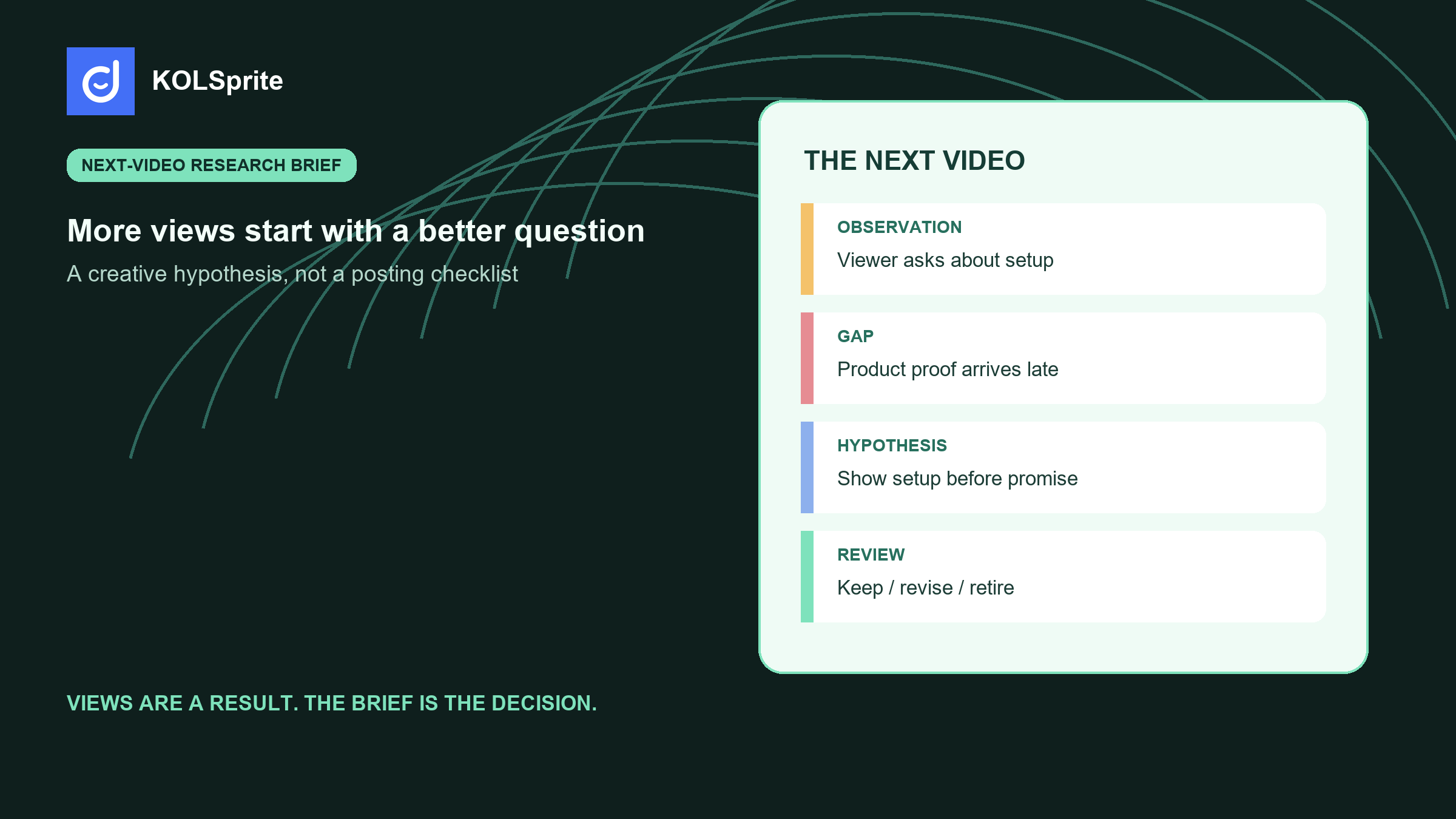
Ten-second answer: Do not chase views as an isolated target. Compare relevant public examples, identify one viewer question and one visible proof gap, then publish an original test that lets the team learn whether the new angle is clearer.
Advice such as “post consistently” is not wrong. But it is weak when it is the whole answer. It cannot tell a team why one product answer held attention while another did not. It also encourages a volume response: make more posts before deciding what to change. That is expensive when a small content team is already unsure which idea deserves another production day.
A stronger process begins with a defined audience situation. What is the viewer trying to understand? What do they need to see before the product makes sense? Which part of the current video asks them to take the claim on trust? Those questions create a creative hypothesis. “We need more views” does not.
TikTok's Creative Center is a useful public starting point for creative planning. It can help a team find formats, trends, and examples to investigate. It should not be treated as a product recommendation engine. A format can be popular and still be a poor fit for your product, audience, margin, or claims boundary. Use it to produce a question, then inspect examples closely.
Source: TikTok Creative Center. Scope: Public trend and creative signals help frame a hypothesis; they do not establish demand or guarantee performance.
When you open an example, look for the moment that changes understanding. It may be a before-and-after setup, a close-up that answers a quality concern, a creator explaining a constraint, or a comment that exposes confusion. Write down that moment in plain language. Do not merely save the clip and label it “good.” The phrase you write should be useful to a person who never saw the original video.
| What to record | What it can support | What it cannot settle |
|---|---|---|
| Viewer question | Names the unknown the video should resolve | A universal audience insight |
| Observed proof moment | Shows what made an example easier to understand | The sole cause of its result |
| Existing video gap | Identifies one element to change | A diagnosis of the whole account |
| New hypothesis | Creates a testable next brief | A promise of higher reach |
| Review signal | Defines what to inspect after posting | A final attribution answer |
Observed-output table. Compare public examples in their original context and keep the source URL and access date with the note.
KOLSprite helps a small content team keep the public example, its visible context, and the next test in one place while they browse TikTok. That is more useful than saving a clip with no note about what the team plans to test.
The tool can support the research step. The team still chooses the claim, the creator, and the test limit. That boundary keeps a view count from becoming a false promise.
The next brief should change one meaningful variable. If the previous video starts with a broad promise, test a specific use case. If the product appears too late, test a visible demo earlier. If comments ask whether the item fits a certain setting, show that setting. Changing the hook, creator, offer, caption, music, editing pace, and product at once gives the team a new video but little learning.
KOLSprite helps with the research portion of that work while you browse TikTok. Teams can review supported public videos, sort and filter relevant sets, inspect subtitles or script structure where open, and study comments with human review. AI Comment Analysis can organize public discussion themes and buyer questions. But it should be used as a cue to reopen example comments rather than a substitute for reading them.
Use KOLSprite to compare supported public TikTok videos, subtitles, and comments while your team identifies one proof gap worth testing.
Register and claim a three-day trial
A Next-Video Research Brief includes five lines: the buyer question, the proof observed, the current gap, the one change to test, and the signal that would make the team keep or retire the idea. That is enough structure to keep a creative conversation grounded. It also gives a creator or editor room to make an original piece of work rather than reproducing an example scene by scene.
The brief should include a limitation. Maybe the examples came from a different price point. Maybe the comments came from a small but vocal group. Maybe the product needs a real customer demo that public research cannot supply. Naming the limit does not weaken the idea. It tells the team what it must learn next.
As posts accumulate, keep the notes. The team will start to see which buyer questions recur, which visual demonstrations make the category easier to grasp, and which creator settings create a believable answer. That is the useful asset behind a view increase: better choices before the next shoot, not a recycled instruction to post more.
Join the KOLSprite Discord to compare creative hypotheses, buyer questions, and the bounded tests that make content reviews more useful.
 +
+
Join the KOLSprite Discord community
After the video is live, return to the original question. Review the visible proof, the comments, and the context around the result. Decide whether the team learned enough to refine, broaden, or stop. A view count can be part of that review. It should not be the only thing the team sees.
Teams can spend so much time thinking about hooks that they stop noticing what a new viewer actually understands. On a fresh review, mute the internal context. Do not assume the viewer knows the category, the product's name, or why the scene matters. Ask what the video makes clear in the first moments and what it asks the viewer to take on faith. The gap between those answers is often a better source of the next test than another list of hooks.
For a product that solves an invisible problem, the proof may need to appear before the answer. For a product with an unfamiliar setup, the answer may need to arrive before the reveal. There is no universal order. The useful observation is the mismatch between the viewer's question and the proof currently on screen.
Keep the comparison set narrow. Three well-chosen public examples from a relevant category are more useful than fifty unrelated viral videos. The goal is not to estimate an average. It is to notice possible ways a viewer's unknown is being addressed and decide which one deserves an original, bounded test.
A weak post is details, not a reason to blame a creator or editor. The review should identify what the work asked the viewer to understand, what proof arrived, and which question was left open. That gives the next owner a usable brief. It also makes it easier to stop repeating a concept that has not earned another attempt.
When the team keeps this discipline, it can treat each published video as a source of proof instead of a verdict on the entire account. That is more useful than chasing a universal answer to how to get more TikTok views, because it improves the only decision the team can actually make today: what to make next and why.
Set a realistic time to reopen the research brief after the new video is live. The exact window will depend on your publishing rhythm and open data. But the point is to prevent instant overreaction. Record what the team planned to learn, then compare the result with that plan. If the proof is mixed, change one part of the brief rather than replacing the whole idea.
This turns creative iteration into a series of visible choices. It also means that a disappointing view count can still create useful proof for the next video.
Keep the new brief next to the published video rather than in a separate planning folder. That connection lets future reviewers see what was intended, what actually appeared, and which question is still open. It is a simple habit that produces better proof than another generic list of view tips.
Use the brief as a comparison tool, not a promise. Its value is that it makes the next choice inspectable before production starts and easier to revise once the team has new public proof.
That discipline also makes reporting more useful. Instead of a vague request to improve result, a content lead can show what changed in the brief, which proof motivated it, and whether the new video addressed the buyer question more clearly.
A useful research loop leaves the next owner with a clearer question, a visible reason for the change, and an honest limit on what the result can prove.
Continue the research: AI comment analysis guide · video downloader research workflow · creator brief template.
This next-video brief links one public observation to one original test and an explicit reason to review it later.
Latest Articles
As an essential, data-driven toolkit for TikTok influencers and marketers, KOLSprite provides powerful features for effortless creator discovery, trending content identification, and actionable real-time insights.
It empowers users to make smarter decisions and significantly boosts their TikTok business.

 Refer & Earn