 +
+
TikTok comments are not a vote on whether a video succeeded. They are a messy record of what people still need explained. That makes them useful for product and creator teams, but only if they are read as evidence with limits. This guide shows how to use TikTok comment mining to find a buyer question worth testing, rather than treating a few loud replies as market research.
If you sell, source, brief creators, or plan content, the practical goal is to turn a repeated public question into one testable next action. You will leave with a small comment-evidence log, a way to separate question types, and a rule for deciding when the signal is too thin to use.
Collect public comments from several relevant posts, group them by the decision they reveal, and look for the question that repeats across formats or creators. Test that question with a clearer demonstration, a creator brief, or a product-page change. Do not call a comment cluster demand until it survives a wider check.
"Love this" can be welcome feedback, but it rarely tells a team what to do next. A question such as "Does it work with curly hair?" or "How long does the battery last in real use?" is more valuable because it exposes a decision that the video did not finish for the viewer.
That does not make every question a priority. Some comments come from people outside your market. Some are jokes, copied phrases, or questions the caption already answers. The useful unit is not an isolated reply. It is a pattern that appears in enough relevant public conversations to justify a small follow-up test.
A comment can also explain why an apparently strong post fails to convert. A video may get attention for an unusual visual while the replies reveal that viewers cannot tell who the product is for, how it works, or whether it fits their budget. Those are content problems with a visible trail.
Before collecting anything, write one question your team wants to answer. Good examples include:
Bad starting questions are too broad: "What do people think?" or "What is trending?" Those questions invite you to collect a pile of comments without a decision attached. A narrow question lets you stop when the evidence is good enough.
A comment rarely makes sense on its own. Read the opening, the on-screen demonstration, the caption, and the nearby replies before tagging it. A viewer who writes "does it really work?" may be reacting to a missing explanation. The same wording beneath a side-by-side test may be an invitation for more detail. Context changes the next action.
It helps to record what the post actually showed. Did the creator demonstrate the product in use? Did they skip the setup? Did they make a price claim without comparing the alternative? This extra line in the log prevents the team from blaming the audience for a question caused by its own content gap.
Set a small threshold before you look. For example: retain a cluster only when the same decision appears in more than one comparable public post and the answer would change a buyer's next step. This is not a statistical test. It is a guardrail against turning one memorable thread into a strategy.
When the signal passes the threshold, record the counterexample too. If another well-matched post answers the same question and viewers do not repeat it, that may mean the problem is the execution, not the product category. That is exactly the distinction a useful content test should help you make.
KOLSprite can help teams inspect supported public comments and surrounding content context. Review the original thread before you turn a pattern into a test.
Register and claim a three-day trial
| Capture | Why it matters | Do not infer |
|---|---|---|
| Post context | Creator, product situation, format, and date explain what viewers reacted to. | That the same question applies to every category. |
| Exact public question | Preserves customer language for a brief or test. | Purchase intent from one question alone. |
| Question type | Fit, price, setup, proof, availability, or trust creates a usable group. | That all mentions have the same meaning. |
| Repeat pattern | Shows whether it appears across related posts or creators. | A market size or conversion rate. |
| Next test | Turns the observation into a video, page, or creator-brief decision. | That the test will produce sales without other evidence. |
Scope: A public-comment pattern indicates a question worth checking. It is not a representative survey, private customer data, or proof of demand.
Most useful buyer questions fall into a small number of groups. Fit asks whether a product works for a specific person, body, home, device, or routine. Proof asks whether the claim can be trusted. Setup asks how much work happens before the benefit. Value asks whether the price makes sense next to an alternative. Availability asks where, when, or in what version the item can be found.
Grouping by decision avoids a common error: counting words instead of meaning. "Will it fit in a carry-on?" and "Could I take this on a flight?" belong together even though the phrasing differs. By contrast, "Where did you get it?" may be an availability question, not evidence that price is the problem.
Keep the original wording next to your label. The label helps you count patterns. The wording helps a creator make a video that sounds like a response to a real person instead of a product brochure.
One creator may attract an unusually specific audience. One video may create a question because it omitted an obvious detail. Before treating a cluster as useful, look at at least a few comparable public posts: different hooks, similar products, or another creator talking about the same use case.
Availability matters as well. TikTok lets account owners control who can comment and can filter or hide comments, so a visible thread is not a complete audience record. Its Manage comments guidance explains those controls. Treat what you can see as a qualitative public sample, not a census.
When the team needs to keep that sample intact, KOLSprite can keep the supported public post, comment context, and short research note together while people review the same question. That saves a simple but real step: no one has to guess which video produced the note. The tool does not turn the thread into private customer data or prove that the question represents a whole market.
Ask three checks:
If the answer is no, save the observation but do not build a campaign around it. A good research habit is knowing when to leave a note unpromoted.
The hard part of TikTok comment mining is often not reading a comment. It is remembering what the viewer had just seen. KOLSprite is useful here because a team can examine public video, creator, and comment context while browsing TikTok, then save the post and its notes together. That makes it easier to see whether the question followed a missing proof point, an unclear comparison, or a creator's specific framing.
Join the KOLSprite Discord to compare public comment evidence, limits, and the next creative test that can answer a real question.
 +
+
Join the KOLSprite Discord community
Use our AI Comment Analysis research guide when you need to group a larger set of public replies, then return to the original thread. The content analytics guide helps turn the finding into a creative choice, while the creator-ready test guide helps write the proof moment without inventing a result.
The product contribution is organization and public-context research, not a declaration that a comment trend equals customer demand. Use its saved examples to build a short evidence set for the next creator brief or content test. Keep the decision human: check the source, note the limits, and choose a modest test before making a larger inventory or media commitment.
The next step should be small and observable. If viewers keep asking how a product cleans, do not create five vague "education" posts. Ask one creator to show the cleanup after ordinary use. If the question is compatibility, show the setup with the devices customers actually mention. If the question is value, show the trade-off without claiming every alternative is inferior.
Write the test in one sentence: "In the next video, show X so that a viewer can decide Y." That sentence prevents a useful observation from turning into an unmeasurable content theme.
Keep that first test small. Pick one post, one clear scene, and one buyer question. Show the part that was hard to see. Then read the new replies with the same care. Did the new clip help? Did a new gap show up? The aim is a better next choice, not a big claim from one thread. This pace gives a lean team room to learn before it spends more on stock, edits, or paid reach.
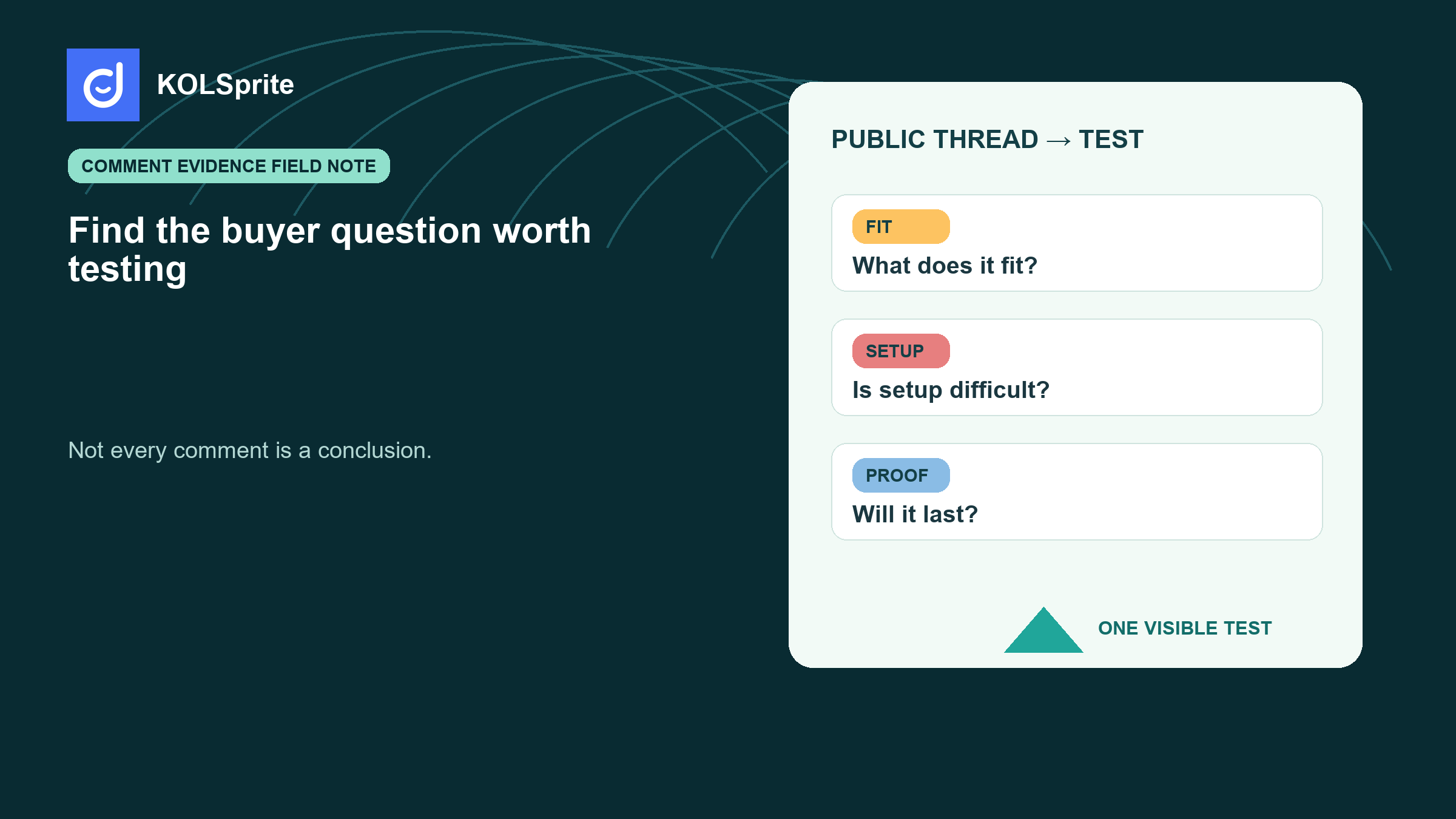
In a weekly review, this can stay very small. Put the source post on the left. Put the buyer question in the middle. Put the next clip on the right. Then mark the date and the owner. That is enough for a team to act. It also makes the next review easy. The group can see what it tried, what the public reply changed, and what still needs a better answer.
Assign an owner and a review date as well. Without those two details, a comment log becomes a museum of interesting quotes. With them, it becomes a source for a single creator brief, a revised product demonstration, or a question added to an FAQ. The output should fit a real work queue.
Comments are weak evidence when the decision depends on private behavior, a regulated claim, a sensitive personal attribute, or a number you cannot validate. They are also weak when a thread is dominated by giveaways, controversy, or a creator's unrelated audience. In those cases, use comments as a prompt for better research, not as a conclusion.
Do not quote individual commenters in marketing material without considering consent, context, and the platform's rules. For an internal research note, summarize the pattern and retain a link to the public post rather than treating people as anonymous testimonials.
Good TikTok comment mining makes the next content decision clearer. It tells you which uncertainty is worth demonstrating, which customer language to preserve, and which claim needs more proof. It does not replace product research, creator judgment, or a real test.
Keep the log small. Preserve the context. State the limitation. Then ask a creator or content team to answer the buyer question in a way that can be seen, not merely asserted.
Latest Articles
As an essential, data-driven toolkit for TikTok influencers and marketers, KOLSprite provides powerful features for effortless creator discovery, trending content identification, and actionable real-time insights.
It empowers users to make smarter decisions and significantly boosts their TikTok business.

 Refer & Earn