 +
+
A TikTok username checker can tell you whether a handle appears to be available at that moment. It cannot tell you whether the name will confuse customers, resemble a creator in your category, or make the brand harder to find after a launch. That second question is where a quick availability check turns into useful brand research. Before you publish your first video, build a short Handle Research Note that records what the name means in the public TikTok environment and who still needs to approve it.
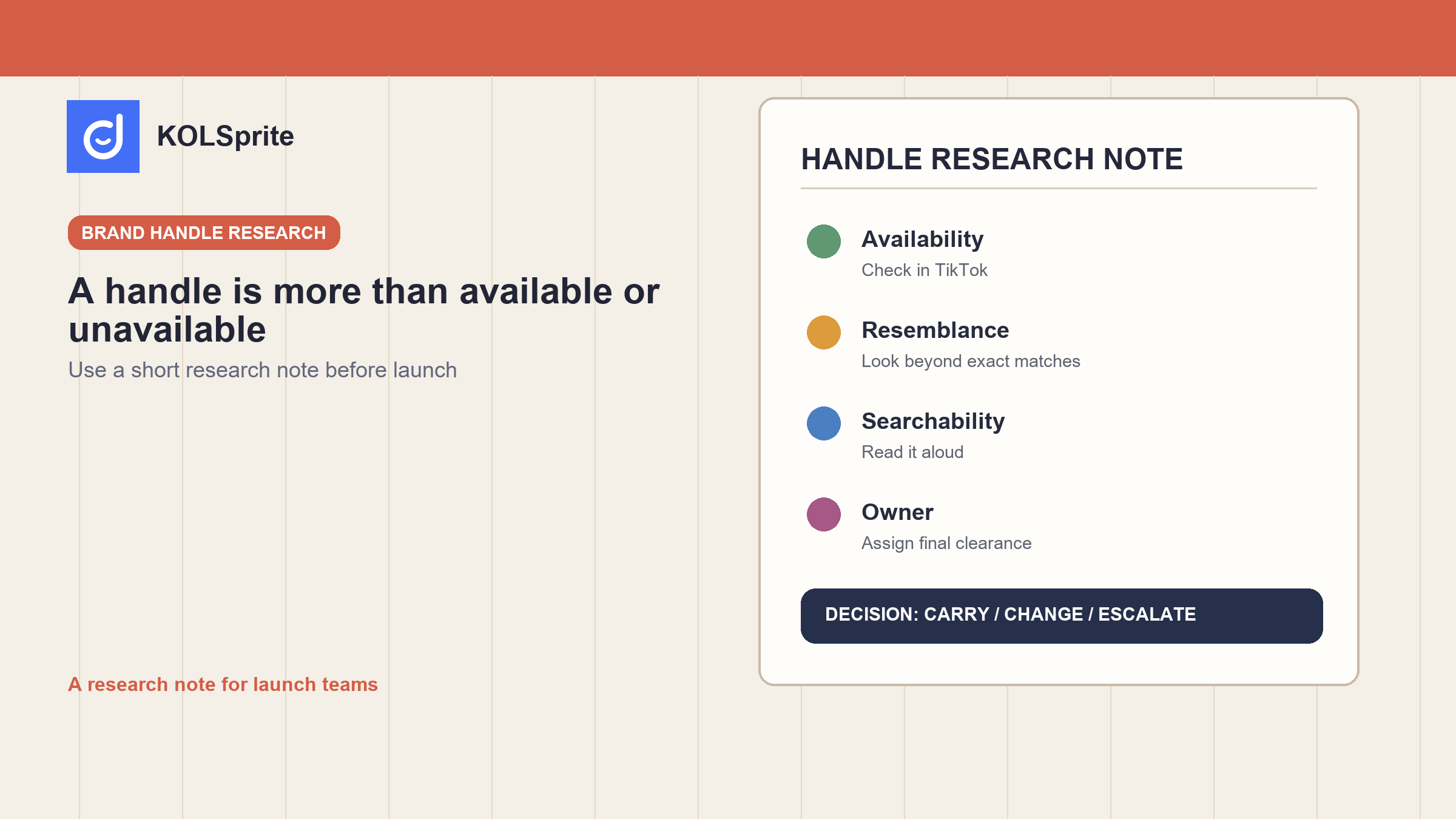
Check availability, then research the handle in context. A usable TikTok handle should be easy to read, distinct from close category accounts, consistent with the brand decision, and cleared by the people responsible for legal and account ownership. Do not let a green availability indicator do all that work.
A handle is available or unavailable. That is a platform state, and it can change. A brand decision has more moving parts. Customers may type the name from memory. A creator may tag it in a caption. A buyer may see it next to similar accounts in search. The name may work in a logo and still be hard to pronounce aloud in a product demonstration.
This distinction matters because teams often make the naming decision while they are rushing to open a new TikTok account. Someone finds an available variation, adds an underscore, and moves on. Weeks later, the same team wonders why comments tag another account, why the handle does not match the packaging, or why its creators keep asking which account to mention.
TikTok controls the username and account-setting rules. Check the current setting in the app and use TikTok's own help content for any changing limits or account requirements. A third-party TikTok username checker is useful for a fast first screen, but it should not be described as a reservation service or a trademark search. Those are different tasks with different owners.
Keep the note short enough that someone will use it. The point is to make a decision visible, not to create a naming workshop. Start with the proposed handle, then record what a buyer is likely to see around it.
| Check | What to record | Decision it supports |
|---|---|---|
| Exact handle | The proposed spelling and any unavoidable variation. | Whether the account can use the brand form consistently. |
| Human reading | How it sounds when a creator says it and how it looks in a small profile header. | Whether people can recognize and repeat it. |
| Public resemblance | Nearby creator, shop, product, or category names that may create confusion. | Whether to keep, qualify, or change the name. |
| Search context | The kinds of content already attached to similar wording. | Whether the account will enter an awkward or irrelevant context. |
| Owner and deadline | Who confirms brand, legal, and account access. | Whether the team can launch without a loose end. |
Source scope: brand-research framework prepared August 25, 2026. Public account and content context can change, and this note is not a trademark, legal, or platform-availability determination.
The note creates a useful separation. The social lead can collect public context. The brand owner can decide whether the name fits the customer-facing language. Legal or counsel can decide whether it creates a rights problem. The person opening the account can confirm the platform setting. Without that separation, the last person who sees an available name often becomes the accidental decision-maker.
KOLSprite helps teams research supported public TikTok creator, video, and category context after they have a handle candidate. It does not reserve usernames or clear trademarks.
Register and claim a three-day trial
Keep the last meeting short. Read each candidate aloud. Put it on a phone screen. Ask one person who was not in the naming process to repeat it after a minute. Then ask what they think the account might sell. These small checks are not research proof. They are a practical way to catch a name that only works because the team already knows the story.
Try a fast five-minute test. Put the name in a draft bio. Put it in a mock creator tag. Put it in a short post title. Then show the three lines to a teammate who has not seen the brief. Ask what the name says. Ask what they expect to find. Ask what they would type to look for it. The goal is not a vote. It is a quick check for a gap between the name in your head and the name a new buyer will see.
Keep the test kind and plain. There is no need to defend a favorite name. Note the words people miss. Note the word they add. Note the first thing they think the brand does. A useful handle does not need to tell the whole brand story. It needs to give the right first cue and leave room for the profile, the product, and the work to do the rest.
A clear result is simple. The chosen handle is easy to say, has a known fallback, fits the public context you reviewed, and has an owner for the remaining account and legal checks. If one of those pieces is missing, the team has not failed. It has found a launch risk early enough to fix.
Exact matching is only one kind of confusion. A handle can be technically different and still sit uncomfortably close to a creator, a product type, or a broader category phrase. Consider a skincare brand called Northline using @northlineglow. That handle may be available, but the team should still look at whether related searches pull in a creator called Northline Beauty, a local salon, or unrelated “glow” content that changes the first impression.
Do not turn this into a claim that search results reveal a name's commercial value. They do not. The goal is narrower: find obvious reasons a customer, creator, or internal teammate might misread the account. If the name creates a frequent need for explanation, that is evidence worth discussing before packaging, creator briefs, and profile links spread it further. Public context also does not settle trademark rights; use the USPTO trademark search guidance and qualified counsel for that separate decision.
KOLSprite can fit this research step once you already have a small list of handle candidates. Its supported browsing and web research workflows can help a team inspect public creator, video, product, and category context close to the TikTok pages being reviewed. That makes it easier to save a few relevant examples beside the note. It does not check handle availability, reserve a username, or clear a name for legal use.
A handle should survive three small tests. First, can a creator say it once in a video without spelling it out? Second, can a buyer type it after hearing it? Third, does it make sense next to the product language the brand plans to use? The answers are usually clearer when you see the words in live category context rather than inside a naming spreadsheet.
For example, a home-organization seller might like a clever name built around “reset.” In public TikTok content, that word can mean a cleaning routine, a wellness habit, a room makeover, or a software restart. The name may still be fine. But the Handle Research Note should say which reading the brand wants and whether the profile, bio, first pinned video, and creator tags will make that reading clear.
That is where public content examples earn their place. They help the team see how a phrase is currently used without treating another account's identity or content as something to copy. Save the example because it exposes a language problem, a visual association, or a naming opportunity. Do not save it merely because it has a high view count.
Join the KOLSprite Discord to discuss public naming context, launch checks, and the questions a simple availability result cannot answer.
 +
+
Join the KOLSprite Discord community
Do not make the fallback version on the spot. A last-minute underscore, extra number, or “official” suffix may solve the availability issue while creating a worse customer problem. Decide the fallback order in advance. It might be the exact brand plus a category word, a market word, or a simple qualifier that can appear consistently across the profile and packaging. Keep the choices readable. A handle that needs a five-sentence explanation is a sign to go back to the name, not to write a better explanation.
The fallback also needs a purpose. If the brand uses a regional qualifier, the team should know whether that reflects its actual market plan. If it uses a category word, the team should check whether the term narrows the brand in a way it wants. A temporary workaround can become permanent once creators, customers, and old links begin using it.
Assign an owner for the final choice. That owner does not need to conduct every check. They do need to decide when the public-context evidence is sufficient, when legal review is needed, and when the launch should pause. This prevents the account setup task from quietly becoming a branding decision without a record.
Once the account is live, the handle becomes part of every creator brief, comment reply, product demo, and link. The best time to find a mismatch is before a creator receives a sample. Add the approved spelling to the brief, include a plain-language pronunciation note if it helps, and give creators the right profile link instead of asking them to search for it.
When your team researches creators or content on TikTok, KOLSprite can help keep public profile and video context attached to that work. For example, a team may use a creator's visible style and category fit to decide whether they are a sensible launch partner. That is separate from the handle decision, but the Handle Research Note can travel with the campaign brief so the same spelling and customer language do not get lost between teams.
For the public identity check, pair this note with the TikTok profile identity audit. If the handle will support product discovery, the rejection-first product shortlist and the content analytics guide help the team connect the name to the category and the content it plans to make.
Do not overstate the connection. Public research is useful for seeing how language appears in the feed. It cannot guarantee a creator will use the name correctly, that a customer will remember it, or that a handle will stay available. Those are reasons to monitor the account and correct the source materials early.
Store the final Handle Research Note with the account owner, launch date, approved spelling, and any unresolved issue. If you later change the handle, you will know what the team originally saw and why it made the call. That is more useful than trying to reconstruct a decision from a chat thread after links and creator assets are already in circulation.
A TikTok username checker is a starting point. The durable work is deciding whether a customer can understand the name in the environment where they will meet it. Public research can make that decision less guessy. The final call still belongs to the people responsible for the brand, the account, and the customer relationship.
Latest Articles
As an essential, data-driven toolkit for TikTok influencers and marketers, KOLSprite provides powerful features for effortless creator discovery, trending content identification, and actionable real-time insights.
It empowers users to make smarter decisions and significantly boosts their TikTok business.
 Refer & Earn