 +
+
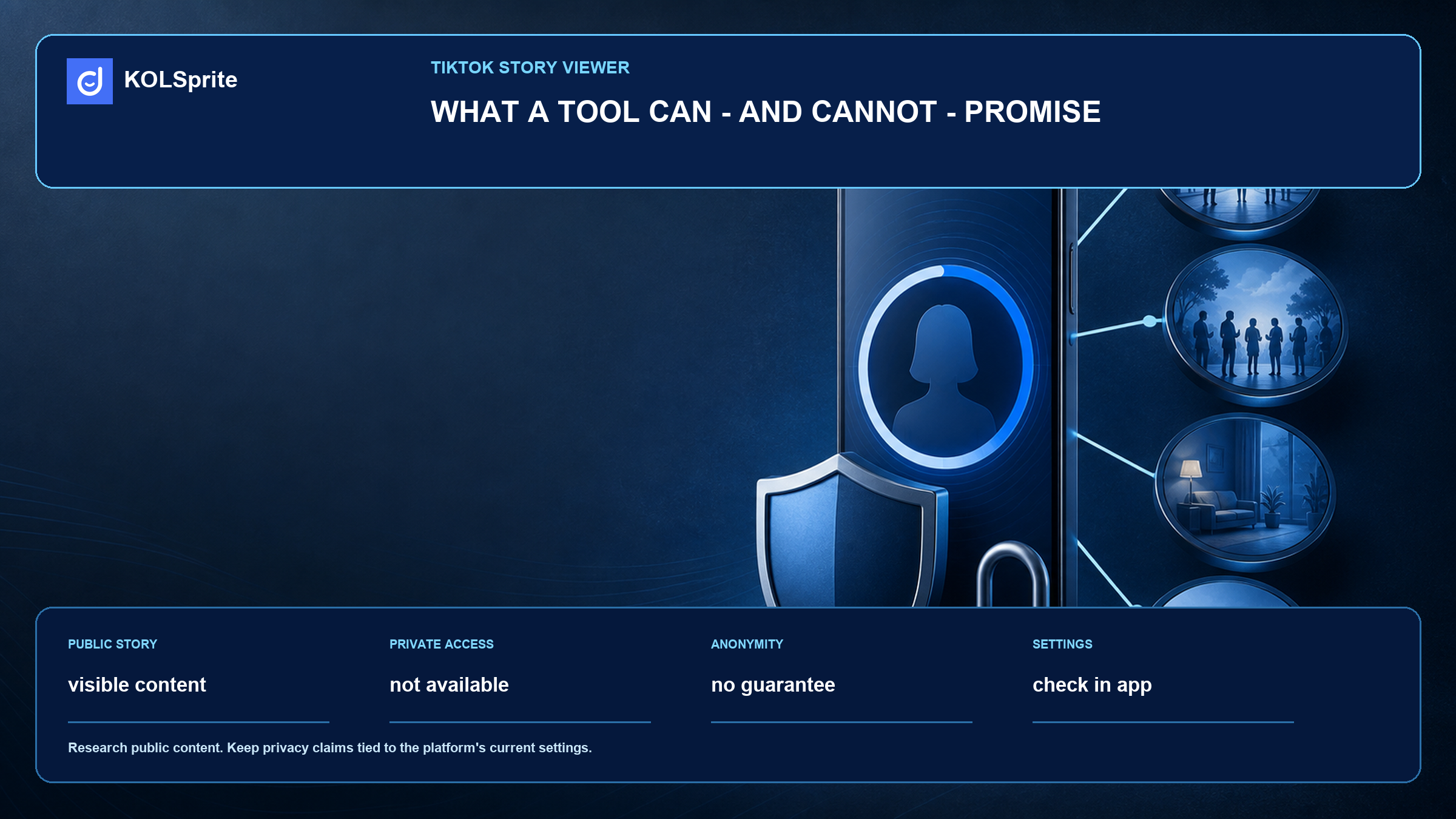
"I only want to check a Story. Will the account know I watched it?" is a fair question, and it deserves a narrow answer. TikTok controls the behavior of its Story feature and may change that behavior or its settings. A viewer should not treat a third-party tool, a browser setting, or a vague claim about anonymous viewing as a way to override those controls.
The practical rule is simple: separate a TikTok Story from a profile view, a regular post view, and a tool claim. Those are different surfaces with different visibility rules. A creator’s ability to see Story-related information is governed by TikTok’s current feature behavior and settings, while profile-view history is a separate TikTok control. The safest choice is to check TikTok’s official guidance and the current in-app settings before viewing.
KOLSprite supports research on supported public TikTok content. It has no access to private profiles or viewer data, and it has no basis to promise anonymous viewing. That boundary is more useful than an overconfident promise because it tells you what sits outside a tool's control.
People often use “view” as though every action on TikTok has the same visibility. That claim has no support. A Story is a distinct feature. A profile is an account page. A regular post is a different content surface. Each has its own interface, controls, and context. The first step is to say which one you are considering before looking for an answer about who can see what.
This matters because advice can travel badly between surfaces. A setting related to profile-view history is not an automatic answer to a Story question. A general post view is too weak to support a promise about Story visibility. When a claim fails to name the surface, it is too broad for a privacy decision.
For creator researchers, the same distinction prevents a different error: treating a public Story as a permissionless source of private account information. Public availability is not a license to bypass a platform’s privacy boundaries. Research should stay within supported public content and the feature’s current rules.
TikTok determines how Stories work, what creators can see, and how the platform presents any visibility information. That means an external “TikTok Story Viewer” has no basis to promise an invisible view, a change to creator-side information, or an override of a privacy setting. Those claims confuse a research tool with the platform that owns the feature.
Before you watch, open the current official Story guidance and check the current TikTok experience. Look for the feature-specific language that applies to the action you are about to take. If your decision depends on whether a creator will see Story viewing information, avoid acting on an old blog post, a search-result snippet, or a tool advertisement. Feature behavior can change.
This approach may feel less convenient than a universal yes or no. It is more reliable. Privacy questions depend on the exact surface, the current platform state, and the account context. A factual answer should preserve those conditions instead of hiding them.
Use this table to keep the privacy question attached to the right TikTok surface. The table is a reading guide to official documentation and current settings, not a promise about a particular account or future platform behavior.
| Surface | Question to check | Reliable boundary |
|---|---|---|
| TikTok Story | What does current Story guidance say about viewing and creator-visible information? | Use TikTok’s current Story documentation and app behavior; do not rely on an anonymity claim from a tool. |
| Profile view | Is profile-view history relevant to this profile action and its current settings? | Profile-view history is its own control and is not an automatic answer to a Story question. |
| Regular post view | What information is shown for this post interaction? | Keep post-view assumptions separate from Stories and profiles. |
| Third-party tool claim | Does the claim say it can hide a view, reveal private data, or bypass settings? | Treat that claim as unsupported. TikTok privacy controls sit outside a research tool's reach. |
Settings and platform behavior can change. This table distinguishes the source of the rule from tool marketing; it provides no private access or workaround around any TikTok control.
Source and scope, August 24, 2026: TikTok’s official support pages for TikTok Stories and profile-view history are the relevant sources for feature and settings context. Their current wording and the in-app experience control; this guidance is limited to public-research boundaries.
Use KOLSprite for supported public TikTok research while keeping Story visibility, private-account access, and platform settings within their real limits.
Register and claim a three-day trial
Profile-view history concerns profile visits. It has its own setting and its own platform explanation. That is useful when the action you are considering is opening an account profile. It offers no shortcut for a Story viewer question. A person who wants to protect their privacy should avoid combining separate pieces of advice into a made-up universal rule.
Read the official profile-view history guidance for the specific control, then read the Story guidance for a Story. If a setting is not described as applying to the surface you are using, do not assume it applies. This keeps the question factual and prevents accidental claims that TikTok has not made.
For a content team, this distinction also keeps research discussions clean. A teammate can record that a public profile was reviewed without implying anything about Story visibility. Clear notes prevent a routine research action from being described as a privacy workaround.
Regular TikTok posts have their own viewing and engagement context. A post can be public, and a researcher may inspect it as part of supported public content research. Stories remain different from posts. It also does not create a right to see private account information, hidden viewer data, or a creator’s restricted materials.
When a website claims one simple “anonymous viewer” answer for posts, profiles, and Stories together, it is likely leaving out the detail that matters. A useful answer names the surface, cites the platform source, and states the limit. For privacy-conscious users, that precision is more valuable than a confident shortcut.
KOLSprite helps ecommerce sellers and content teams analyze TikTok while browsing, find creators, research products, and move from signal to action. Its public-research role can include supported public TikTok browsing and supported public content research. Public availability may change, and the extension has no access to private accounts or complete market coverage.
That capability stops well before privacy circumvention. KOLSprite has no access to private viewers and no basis to promise anonymity or a result controlled by TikTok. It should also not be described as a way to see private profiles. Keeping this line clear protects viewers, creators, and teams that need their research practices to remain within public boundaries.
Use a tool for what it can responsibly support: organizing observations from available public content. Use TikTok’s own interface and documentation for questions about privacy controls and feature behavior.
A safe boundary can fit in three sentences. First: review only content that is publicly available on a supported surface. Second: the safe rule is to avoid private account information, hidden viewer lists, or workarounds around platform settings. Third: when the question concerns whether an account can see a particular action, check the official feature-specific source before acting.
This boundary helps a creator researcher avoid overreach and gives a privacy-conscious viewer a sensible default. It also makes internal guidance easier to follow. There is no need to invent special procedures when the right path is already clear: public research stays public, and privacy rules stay with the platform.
The Question Should Come Before the Click.
For repeated research work, use a short decision note. Record the date, the TikTok surface, the action under consideration, the official source checked, and the conclusion you can actually support. For example, a note can say that the team reviewed the current Story guidance before deciding whether to view. It should not say that a tool guaranteed anonymity unless TikTok’s own current information supports that precise claim.
The note becomes especially useful when several people share research tasks. It keeps one person’s memory of a setting from becoming a policy for everyone else. It also gives the team a reason to refresh the review when the platform changes its interface or documentation.
Join the KOLSprite Discord to compare public-research boundaries and current platform settings without relying on anonymity claims.
 +
+
Join the KOLSprite Discord community
For adjacent questions, start with this explanation of whether TikTok shows who viewed, then compare it with this guide to the phrase TikTok anonymous viewer. Teams that need to understand what is available on a public account can also use this TikTok profile analyzer identity audit as a research-boundary reference.
Keep the same standard across all three: identify the exact feature, rely on the current official rule for that feature, and reject claims that a tool can bypass a privacy control. KOLSprite supports public content research within supported surfaces. It makes no promise of anonymous Story viewing or private access.
Start by naming the surface. Is it a Story, a profile, or a regular post? Those are different product surfaces. A rule for one may not apply automatically to another. This first step keeps a viewer from relying on a broad claim that fails to fit the feature in front of them.
Next, open TikTok's current help page for that feature and read the setting that applies. Check the app if the help page points to a control there. Record the date and the feature name in the team note. This takes a few minutes and gives the team a source it can explain later.
Keep tool claims in their proper place. A public research tool may help a team inspect content that is already public. It has no way to turn a private account public. It has no way to hide a Story view. It has no way to change a creator's platform settings. Those are platform rules.
When the answer is unclear, pause rather than guess. A careful reader can choose not to view until the current Story rule is clear. That is a better result than an anonymity claim that a tool cannot support.
This boundary also helps teams write safer internal notes. Say which feature was checked. Link to the source. State the public-research limit. Keep the note factual. It will remain useful even if the platform changes the screen later.
A TikTok Story Viewer search often starts with a simple privacy concern. A TikTok Story Viewer article should give a source-based answer, not a broad promise. The useful result is a short, dated note that says what was checked and what no tool can change.
Use the same note each time. Write the feature name. Write the date. Save the official source. State the public limit. That is enough for a careful review.
Keep the note short. A long note can hide the rule. The rule should be easy to find. It should be easy to read. It should be easy to check.
A tool ad is not evidence. An old post is not evidence. Add only the rule you checked. Add only the setting that fits the feature. This helps the next person avoid the same bad guess.
For a public content task, the team can still do useful work. It can note the format of a Story that is open. It can note the first shot. It can note the product use. It can note the words a creator puts on screen. These are public research notes. They need no privacy promise.
For a private or unclear surface, stop. The right action may be to leave it alone. That choice can be useful. It can keep a team from making a claim that lacks support.
When the platform changes, check the rule again. Change the date in the note. An old answer should stay with its original case. The old answer may no longer fit the screen.
Use the rule that fits the screen. A note for one screen should stay with that screen. A Story rule is for a Story. A profile rule is for a profile. This small habit can stop a bad privacy claim.
The safe answer is short. Check the feature. Check the current rule. Check the setting. Then decide if the content is public. If the rule is not clear, stop. Tool claims must match its actual role. Platform claims must match the current official rule. Link to the source in the note. That gives the next reader a clear place to start. It also keeps the team from passing on an old privacy tip.
Use plain words in the note. Story. Profile. Post. Public. Private. Date. Source. These words make the check easy to read. They also make it easy to review when the app changes.
Read the note before you view. If the rule fits, act with care. A mismatch calls for a pause. This short pause can keep a simple task safe and clear.
For most cases, the privacy check is short. Name the screen. Read the current help note for that screen. Check the app setting when the note points to one. That is enough to make a sound call. A tool may help with public research notes, but TikTok sets the rule. A user setting may change the result. The best next step may be to wait, read the current note, or ask the account owner. Good privacy work stays calm, names the limit, and sticks to facts.
Each check can be brief. Keep a date, a link, and a plain note. The note can say what you read, what it means, and what you will do next. A short note is enough. It needs the right screen and the right rule. A team can use the same note when it plans a post, checks a Story, or reviews a tool claim. Clear facts help people make a good call and move on.
Latest Articles
As an essential, data-driven toolkit for TikTok influencers and marketers, KOLSprite provides powerful features for effortless creator discovery, trending content identification, and actionable real-time insights.
It empowers users to make smarter decisions and significantly boosts their TikTok business.
 Refer & Earn