 +
+
A busy comment thread can feel like a vote of confidence. It can also hide the one question that should change the next product video. Praise, jokes, tagging, one-off requests, complaints, and genuine buyer concerns all arrive in the same stream. The job is to find a repeatable objection without treating a handful of public comments as representative research or proof of demand.
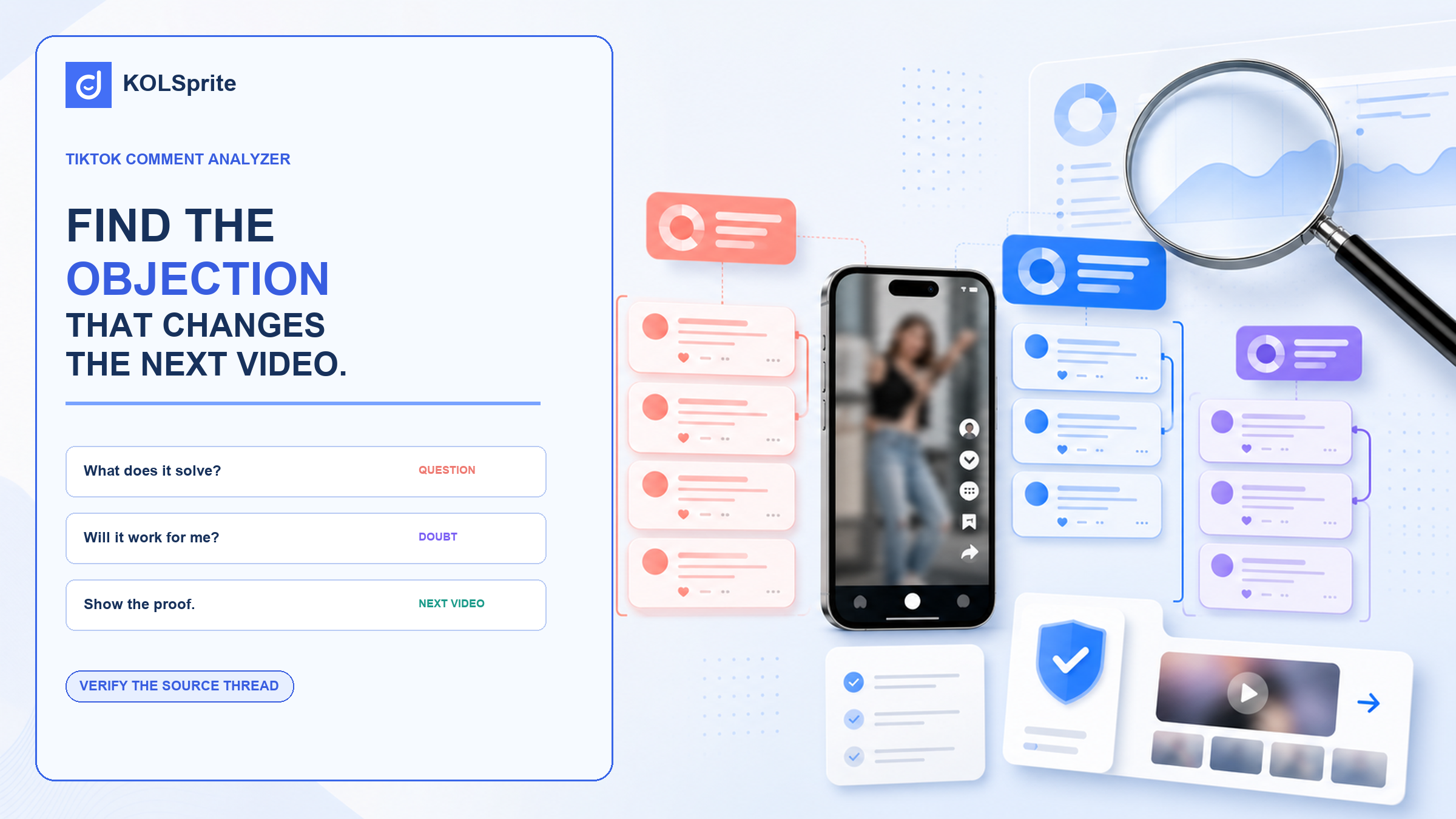
A TikTok comment analyzer is most useful when it turns a crowded thread into a visible content question. It should help a team see an objection, return to the original comments, and decide what the next video needs to prove. It should not turn an AI summary into a finding that no one has checked.
Here is a practical comment clinic. The goal is one bounded Objection-to-Proof card: a note that identifies a visible concern, the source context, and a next-video brief that can answer it honestly.
Begin with a question tied to the next video, not a question about overall sentiment. A useful question might be: “What uncertainty would stop a viewer from trying this product after seeing this demonstration?” That wording focuses the review on buyer friction. It also gives praise and general chatter a proper place: they may be useful context, but they are not automatically the next creative instruction.
Review the public video and its comments together. A remark about size may refer to an object visible in the frame, while a question about price may be answered in the caption or a reply. Context changes meaning. Read enough of the surrounding thread to understand whether a comment is a serious objection, a response to another user, a joke, or a one-time request.
On a supported public TikTok video, KOLSprite can be used to inspect available public content. Where AI Comment Analysis is supported, it may help group visible themes. The underlying public comments remain the source. The AI output requires source review before a team makes a creative decision.
Use simple working labels while reading. Praise includes reactions that affirm the creator or product without naming a barrier. Noise includes tags, unrelated jokes, duplicate phrases, and comments that cannot be interpreted without missing context. Requests ask for another color, setting, use case, or comparison. Objections identify a reason someone might hesitate: concern about fit, shipping, durability, setup, safety, price, or whether the demonstration is realistic.
Do not force every comment into a useful category. Ambiguous items can stay ambiguous. The purpose of labels is to make a practical comparison possible, not to make a thread look cleaner than it is. When a theme appears, save the exact context internally so the writer or creator can see what the user was reacting to.
For a product team, the important distinction is between a request for more content and a barrier to action. A request may provide an excellent future topic. An objection is more urgent when it can be answered visibly in the next version of the video.
The labels below are synthetic examples for demonstrating a review method. They are not real customer data, a sentiment study, or evidence about any product.
| Synthetic label | What to verify in the original public thread | Possible next-video response |
|---|---|---|
| Shipping concern | Whether multiple viewers are asking about delivery timing or destination, and whether replies already answer them | Show only shipping information the seller can substantiate; avoid unsupported promises |
| Fit question | Which product size, surface, body type, or use condition the viewer means | Film the relevant fit condition and state the limitation plainly |
| Praise | Whether the comment includes a specific proof point or is simply a positive reaction | Keep as context; do not treat it as an objection by default |
Check the original comments before acting. A small public sample may be skewed by the video, the creator, the timing, reply order, or moderation. It cannot establish representative customer sentiment or demand.
Source and scope, August 24, 2026: TikTok’s comments support guidance explains the platform comment surface. The KOLSprite guide to AI comment analysis for TikTok research describes a supported research workflow. Public comments and AI-generated groupings require source review and are not representative market research.
KOLSprite AI Comment Analysis can group visible themes from supported public comments. Review the source thread before deciding what your next video should prove.
Register and claim a three-day trial
One dramatic comment can pull a team off course. Look instead for a pattern that remains meaningful after context is checked. The wording does not have to match exactly. Several viewers may express the same hesitation in different language. The important test is whether they are pointing to the same visible uncertainty.
For each possible theme, ask three questions. Does it appear more than once in the public material reviewed? Does the original context show that it concerns the product or promise rather than an unrelated detail? Can the next video answer it with an honest visual demonstration? A theme that fails one of these tests can remain in the research notes without becoming the lead brief.
This is where editorial judgment matters. A creator team may see lots of applause and still choose to answer a smaller but more consequential fit concern. The decision is not a popularity contest. It is a choice about what uncertainty the next video is best placed to resolve.
An objection becomes useful when it changes what the camera has to show. “Viewers are unsure about fit” is a theme. “Show the product on the relevant surface from a close distance, state the applicable condition, and do not hide the limitation” is a proof requirement. The second sentence can guide an actual production.
Keep the proof specific and truthful. Do not use a comment theme to make a claim the product cannot support. If the product has a limitation, the video may need to show that boundary. Clear boundaries often make a product demonstration more credible because the viewer can see what the product is and is not intended to do.
Where supported, AI subtitles, summaries, script analysis, and rewriting can help turn notes into a first brief. Treat that output as a draft. The team should compare it with the original public thread and product facts before it reaches a creator.
The card should fit on one screen. Start with the video and comment-review date. State the theme in neutral language, then list the source context the reviewer checked. Add the production question: what must a viewer see or understand to reduce this uncertainty? Add one prohibited shortcut, such as “do not imply universal fit” or “do not promise a delivery window without confirmation.”
Finish with a brief format: opening situation, proof shot, explanation, and close. That structure gives the next video a job without making it a generic list of feature claims. It also allows a creator to make the execution feel native to their audience.
A strong comment review also creates exclusions. Praise may be worth saving for future social proof review, but it does not need to steer the edit. One-off requests can be held for a separate content idea. Hostile or irrelevant messages may need no creative response at all. Keeping these categories apart makes the next brief shorter and more useful.
There is value in saying, “This thread does not contain enough checked repetition to change the next video.” That finding protects the team from inventing a theme because it wants the analysis to produce an answer. A public comment sample is limited evidence. Sometimes the honest next step is another review after more relevant content is available.
Join the KOLSprite Discord to compare buyer questions, source checks, and the next-video ideas that answer a real objection.
 +
+
Join the KOLSprite Discord community
For a deeper explanation of the workflow, use the source guide to AI comment analysis cited above. The next decision should also be consistent with the team’s broader view of TikTok content analytics and creative choice. When the objection is ready to become a creator assignment, use this guide to creator-ready script tests to shape the proof into a bounded brief.
KOLSprite can help analyze supported public TikTok content while browsing. It does not turn a public sample into representative research, sentiment measurement, or proof of demand. Use the tool to organize attention, then make the final edit decision from the original context and the product facts.
Suppose the repeated question is about fit. The next brief can ask for one close shot that shows the fit, one line that names the limit, and one final view that shows the result. The team does not need to answer every comment. It needs to answer the one question that a viewer can verify in the video.
Keep the source note beside the shot list. It should say which public thread was reviewed, when it was reviewed, and why the theme was selected. It should also say what the thread does not prove. A small sample may point to a useful proof gap. It cannot stand in for a survey or a demand forecast.
After the video is edited, compare the cut with the card. Is the proof on screen? Is the claim still true? Did a new promise slip into the caption? This is a quick review. It keeps the final post tied to the question that started the work.
That is where a comment-analysis tool earns its place. It helps a team sort a crowded public thread. The team still chooses the claim, the evidence, and the final creative decision.
A TikTok comment analyzer can help bring the right thread to the surface. It cannot decide what the viewer will believe. The proof card gives the editor a clear job, and it gives the reviewer a clear way to check the final video.
Read the proof card once before the shoot. Read it again before the post goes live. The same short card can keep the idea clear from research through editing.
Keep the rule simple. One checked doubt. One true claim. One proof shot. That is enough for the next edit. A short card can stop a vague video from going live.
Play the clip once with no sound. Can a viewer see the proof? Play it once with sound. Does the claim match the shot? Read the caption. Does it add a new claim? These checks are small. They can catch a weak edit. They can also keep a good idea from growing into a big promise. The card gives the team a fast way to check the final post.
Keep the post close to the source. Show the fact. Name the limit. Let the viewer see the proof. A clean edit can answer more than a long sales line.
Latest Articles
As an essential, data-driven toolkit for TikTok influencers and marketers, KOLSprite provides powerful features for effortless creator discovery, trending content identification, and actionable real-time insights.
It empowers users to make smarter decisions and significantly boosts their TikTok business.

 Refer & Earn