 +
+
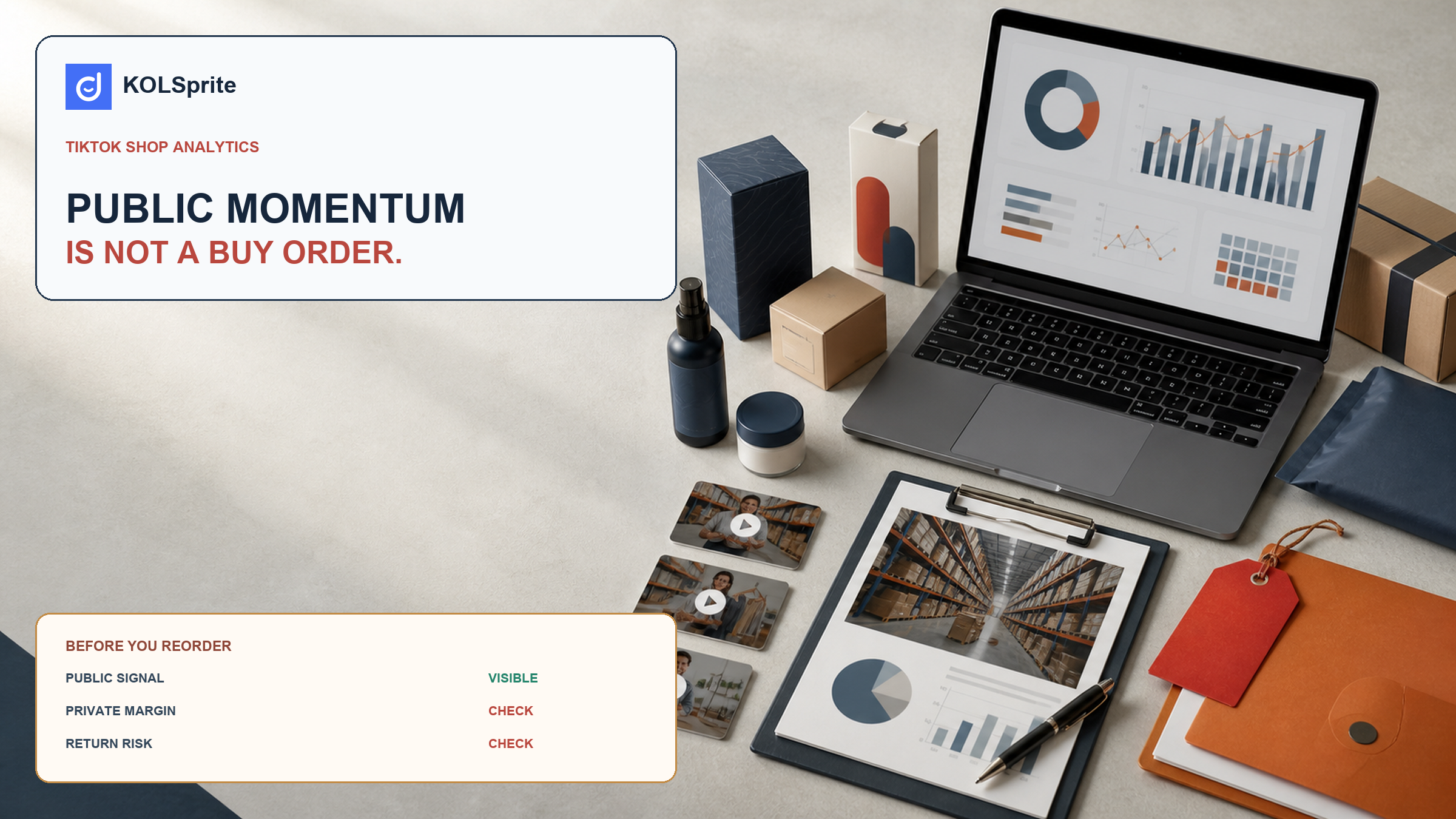
A dashboard can make a product look ready for a larger purchase order. That feeling is understandable. Public shop activity, product videos, creator interest, and rankings can point to visible momentum. Yet a seller still needs a different set of answers before committing more cash to stock. Public signals can narrow the question; they cannot supply the private proof that makes an inventory decision defensible.
That gap is where a TikTok Shop analytics tool earns trust. Its value is not a green light by itself. Its value is helping a seller separate what the market can see from what only the seller’s own systems can answer. That separation prevents a familiar mistake: treating attention as a substitute for margin, stock health, return exposure, or supplier reliability.
The five questions below turn visible momentum into an inventory memo. Each one ends with a hold condition. A hold condition is not a failure to decide. It is a clear reason to pause until the missing evidence is available.
Start by describing the visible motion with care. Is the product appearing in more public videos? Is one creator’s video driving the conversation? Are several shops presenting a similar item? Are comments centered on a specific use case? Public product, shop, video, and creator research can help you observe these patterns. Rankings and fields are time-sensitive, and their coverage can change, so record the date and the surface you reviewed.
Do not collapse these signals into “demand.” A product may receive attention because of an unusual demonstration, a seasonal moment, a price cue, or a creator’s existing audience. That attention can be commercially important, but it has to be described before it can be weighed. Write a short statement such as: “Public videos are repeatedly showing the travel-use demonstration, while comments ask about size and durability.” This is a usable observation. “The product is hot” is not.
KOLSprite can support public research across product, shop, video, and creator surfaces. Use it to collect a bounded set of relevant examples and identify the question that deserves closer review. It cannot prove demand, profit, supplier quality, return risk, or future sales.
Now leave the public surface and open the seller-side records. The purchase order should be supported by landed cost, selling price, fees, fulfillment cost, promotion cost, expected return or refund exposure, and the cash required to carry the inventory. These are private business facts. A public content pattern cannot supply them.
Ask the finance owner or operator for a current view of contribution after the costs that apply to this item. Ask whether the proposed order changes storage fees, inbound timing, bundle economics, or the ability to fund another proven item. A larger order can look attractive in isolation while weakening the wider catalog. The right question is not whether a public video looks strong. It is whether the next units have a credible financial case in your actual business.
Set a hold condition in plain language: hold the reorder until current landed cost, fee assumptions, and return exposure are confirmed in the seller’s own systems. That sentence protects the team from carrying public excitement into a private financial decision without the needed proof.
Use this comparison when writing the inventory memo. The left side can guide where to investigate. The right side must come from the seller’s own records, agreements, and operating checks.
| Decision area | Public signal that may be useful | Private proof required before more stock |
|---|---|---|
| Creative traction | Repeated product demonstrations or audience questions in public videos | Your own conversion, attribution, and channel performance review |
| Unit economics | Visible price positioning and offer language | Landed cost, fees, fulfillment cost, promotion spend, and contribution view |
| Supply readiness | Public availability claims or shop listings | Supplier confirmation, quality checks, inbound plan, and lead times |
| Risk | Public questions or complaints that suggest friction | Return, refund, compliance, and customer-service records |
The table is a decision aid, not evidence that any product will sell or remain profitable. Public signals are incomplete and may change; private proof has to be current for the seller making the purchase decision.
Source and scope, August 24, 2026: TikTok Shop Seller Center University is a seller-side policy and operating reference, while TikTok Creative Center is a public discovery surface. Neither source supplies your private cost, margin, stock, or returns information.
KOLSprite helps you investigate public product, shop, creator, and content context before your team checks margin, stock, supplier, and return evidence in its own systems.
Register and claim a three-day trial
A product category can get attention while your exact offer remains unproven. Compare the public examples with your own product page, price position, shipping promise, bundle, and demonstration. Does the visible interest depend on a use case your listing makes clear? Is the creator showing a feature your version has? Are shoppers asking questions your customer service process can answer? These comparisons may expose a mismatch before additional stock makes it expensive.
Use public research to find the wording and proof points that recur. Then check the seller’s own product facts. Do not imply that a public ranking validates the product claim, its quality, or its fit for a specific buyer. The useful result is a short list of offer questions: what does the buyer think they are getting, what proof do they need, and can your operation deliver it consistently?
Hold if the visible momentum depends on an offer your business cannot honestly make. The next step may be improving a product demonstration, clarifying a listing, or choosing a smaller test. It does not have to be a larger order.
Inventory decisions deserve an explicit downside review. Look for what would make the visible public pattern less relevant: a competing item with a clearer promise, a creator-driven moment that does not transfer, a policy limitation, a shipping constraint, a quality issue, or a rise in returns. This is not a forecast. It is a list of facts that the team needs to check before treating a bright signal as durable.
Assign each risk to an owner. Supply owns confirmation of lead times and quality process. Operations owns inbound capacity and fulfillment timing. Finance owns the cash and margin view. Compliance owns the relevant product and claims review. Content owns the evidence behind the creative angle. A memo without owners creates a meeting; a memo with owners creates a decision path.
Hold if a named risk has no source of proof. That condition helps avoid dashboard theater, where an attractive screen receives more authority than the operational work required to support the order.
When the evidence is mixed, the answer may be a smaller replenishment, a controlled creative test, or a pause while the private checks finish. The smallest reversible move is useful because it preserves cash and creates a clearer next observation. It should have a defined owner, a short review point, and a statement of what would change the next inventory decision.
A reversible move is not a vague compromise. It should name the product, the channel or creative question, the available stock position, and the proof still missing. For example: “Maintain the current reorder plan while the team verifies supplier lead time and reviews returns tied to the travel-use promise.” This is more actionable than “monitor the trend.”
Keep the memo to one page. Open with the public observation and its date. Then answer the five questions in order: what is visible, whether your numbers support more units, whether the interest fits your offer, what could reverse the picture, and what reversible action is available. Each answer should point to the owner or system that can validate it.
End with one status: proceed, proceed with a limited commitment, or hold. A hold needs an explicit condition, such as missing cost confirmation or unresolved return exposure. This gives the decision-maker a useful no without pretending that a public tool can fill a private data gap.
Join the KOLSprite Discord to discuss public momentum, inventory holds, and the commercial checks a dashboard cannot answer.
 +
+
Join the KOLSprite Discord community
Public TikTok research can be valuable early in the process. It can show how a product is being demonstrated, which creator styles make the use case clear, and which buyer questions keep appearing. For a practical method, read this guide to separating TikTok Shop product momentum from demand. Use a rejection-first product shortlist to eliminate ideas whose public story does not fit your offer or operating limits. The next step is this framework for product research, rejection, and a bounded test.
KOLSprite supports public product, shop, video, and creator research. It does not report profit, margin, inventory, supplier quality, refund risk, or future sales. Keep those boundaries visible in the memo. The result is a stronger stock conversation because every signal is given the amount of authority it actually deserves.
A one-page memo is easiest to use when it makes the gap visible. Put the public observation at the top. For example, a team may see several recent videos that show the same product use. That tells the buyer where to look. It does not tell the buyer how many units to order.
Below that, list the private checks in plain language. Is the landed cost current? Is stock already committed to another channel? Has the return reason changed? Does the offer match the use case shown in the videos? Give each check an owner and a due date. The memo then turns a busy screen into a short list of business facts.
The closing decision can be modest. A seller may keep the current reorder, run one creative test, or wait for a missing cost check. Each choice is valid when the reason is visible. The goal is not to make public activity prove a purchase. The goal is to let public activity ask a better question before cash is committed.
Keep the memo when the decision is over. Later, compare the signal with the result in the seller's own records. That comparison can improve the next reorder conversation without claiming that a public dashboard predicted the outcome.
A TikTok Shop analytics tool can make the public side faster to inspect. The approval page still needs the private side. That simple split helps a buyer see what is known, what is missing, and what should happen next.
Use the page in the buy meeting. Read the public signal first. Then read each private gap. Stop when a gap can change the order size. This keeps the call calm and clear.
A team does not need more charts at this point. It needs the next fact. The fact may be a cost, a return note, or a date. Once that fact is checked, the buyer can make the next call.
Use the memo to make one clear call. Buy less. Hold the buy. Or test one small idea. Each call has a cost. Each call needs a fact. The memo shows the fact. It also shows the gap. That is enough for a sound next step.
State the buy rule in one line. State the hold rule in one line. State the next check date in one line. A buyer should see the risk fast. A buyer should also see the path to a yes. That path may be a new cost sheet. It may be a return check. It may be a stock count. The key is to name it. A clear gap is better than a false green light.
Keep the answer on one page. What did we see? What do we know? What must we check? Who will check it? When will we decide? Those five lines can keep the stock call clear. They can also show when the team needs to wait.
Latest Articles
As an essential, data-driven toolkit for TikTok influencers and marketers, KOLSprite provides powerful features for effortless creator discovery, trending content identification, and actionable real-time insights.
It empowers users to make smarter decisions and significantly boosts their TikTok business.

 Refer & Earn