 +
+
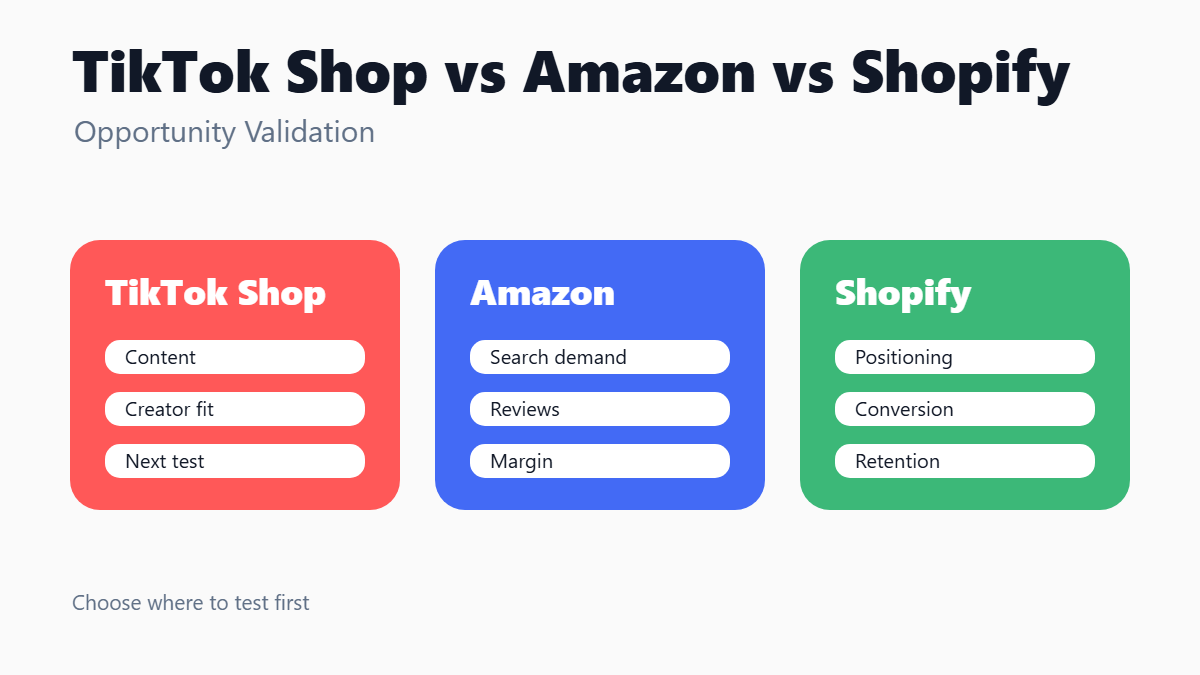
TikTok Shop vs Amazon vs Shopify is the process of using TikTok videos, creators, comments, and content momentum to validate whether a product deserves attention beyond its Amazon or Shopify data. For sellers and brands deciding whether a product should be tested first on TikTok Shop, Amazon, Shopify, or through creators before full launch, the best workflow is to combine marketplace demand, store economics, TikTok content evidence, and creator-product fit before committing budget.
KOLSprite supports this workflow by helping teams analyze TikTok while browsing, research videos and creators, compare product signals, and move promising findings into outreach, briefs, or campaign tracking. The goal is not to chase every trend. The goal is to know which trends are usable for your product, margin, and channel strategy.
The same product can look strong on one platform and weak on another. A search-driven product may not have a TikTok story. A TikTok trend may not have margin. A Shopify hero product may need creator proof before ads can scale.
That gap matters because Amazon, Shopify, and TikTok create different kinds of confidence. Amazon can validate search demand and marketplace competition. Shopify can validate owned-store positioning, pricing, and conversion. TikTok can validate whether the product has a story that creators can show in motion.
The Firehose package behind this batch showed strong signals around TikTok Shop affiliate programs, analytics tools, live commerce, listing discipline, Amazon research tools, and Shopify affiliate topics. The common thread is operational: sellers are trying to understand where TikTok fits into a broader ecommerce system, not as a standalone experiment.
The practical workflow is to use Amazon for search-demand validation, Shopify for owned-store conversion and positioning, TikTok for content and creator validation, then choose the next test based on the weakest missing evidence. This keeps the team from treating a TikTok trend as proof by itself. A trend is only useful when it can survive product, creator, content, and channel checks.
A brand sees high Amazon demand for a posture device and strong Shopify margin. TikTok research shows creators struggle to demonstrate it quickly. The right decision is not to abandon the product. It is to test a desk-worker pain angle and longer educational creators before scaling.
This is the kind of detail that separates trend research from trend watching. Watching creates screenshots. Research creates a decision: test, skip, reposition, brief a creator, adjust the product page, or build a new shortlist.
| Signal | Amazon view | Shopify view | TikTok view | Decision use |
|---|---|---|---|---|
| Demand | Search demand, reviews, category competition | Store traffic, add-to-cart, conversion | Views, saves, comments, creator repetition | Decide whether the market is active enough to test |
| Buyer language | Review phrases and Q&A | Support tickets, reviews, survey replies | Comment questions, objections, slang, use cases | Rewrite product pages and creator briefs |
| Content fit | Image and listing clarity | Landing page story and UGC assets | Hook, demo, proof, objection handling, creator format | Choose the first content angles to test |
| Creator fit | Not visible inside marketplace data | Affiliate and UGC partner history | Recent creator content, niche fit, comment intent | Build a qualified creator shortlist |
| Scale risk | Inventory, margin, ranking pressure | Ad cost, conversion rate, fulfillment | Trend fatigue, weak creator supply, compliance risk | Choose a small test before a full launch |
| Criteria | Score 1 | Score 3 | Score 5 |
|---|---|---|---|
| Problem visibility | Problem is hard to show | Problem can be explained | Problem is obvious in the first 3 seconds |
| Creator supply | Few relevant creators | Some niche creators | Many creators already discuss similar problems |
| Comment intent | Generic reactions | Some questions | Repeated questions about use, price, comparison, or where to buy |
| Product economics | Weak margin or fulfillment risk | Testable but constrained | Healthy enough for samples, creators, and iteration |
| Content repeatability | One lucky video format | Two or three possible hooks | Multiple creators can repeat the format naturally |
Do not publish this score as a promise. Use it as an internal operating filter. A product with a lower score may still work, but it needs a narrower test and a clearer reason.
KOLSprite is useful here because the work happens while operators are already browsing TikTok. Instead of copying links into a spreadsheet and losing the context, teams can use KOLSprite as a research workbench.
Use KOLSprite to evaluate TikTok content and creator fit before choosing where a product deserves the next budget.
Turn this workflow into a weekly operating rhythm instead of a one-time research sprint. Each week, review the saved TikTok videos, comments, creator profiles, and product notes tied to TikTok Shop vs Amazon vs Shopify. Separate new signals from repeated signals. A new viral post may be interesting, but repeated buyer questions, repeated creator formats, and repeated objections are usually more useful for Amazon and Shopify operators because they indicate patterns that can survive beyond one video.
Use a simple status system: watch, validate, brief, test, scale, or archive. A product idea should move forward only when the team can explain the customer problem, the creator type, the content angle, the proof moment, and the next commercial action. That cadence keeps TikTok research tied to inventory, landing pages, creator outreach, and paid testing instead of becoming another folder of saved videos.
Want to compare TikTok trend research notes with other ecommerce operators? Join the KOLSprite Discord community for creator research, product research, and campaign workflow discussions.
 +
+
Join the KOLSprite Discord community
Amazon sellers should use TikTok trend research to validate content fit, creator fit, buyer language, and visual proof. Amazon demand is useful, but TikTok decides whether the product can be explained through short-form content and creators.
Shopify brands should compare store performance with TikTok comments, creator content, and repeated video angles. The goal is to improve product pages, creator briefs, UGC tests, and paid social ideas with real audience language.
No. Treat a TikTok trend as a signal, not a final decision. Check margin, fulfillment, compliance, creator availability, comment intent, and whether the content angle can be repeated by more than one creator.
Track product idea, channel source, TikTok content examples, comment themes, creator fit score, Amazon demand signal, Shopify conversion signal, sample status, content links, and next action.
KOLSprite helps teams analyze TikTok while browsing, research videos and creators, connect product signals with creator fit, and organize campaign decisions instead of relying on scattered tabs and manual notes.
Latest Articles
As an essential, data-driven toolkit for TikTok influencers and marketers, KOLSprite provides powerful features for effortless creator discovery, trending content identification, and actionable real-time insights.
It empowers users to make smarter decisions and significantly boosts their TikTok business.
 Refer & Earn