 +
For a US seller researching TikTok jewelry trends, a style name should start the investigation, not settle a stock order. Turn the look into a specific item: its shape, material claim, price and way of being worn. Then compare like products and inspect samples. This guide uses three current jewelry listings to show what that research can reveal, what still needs checking and how to define a small buying test.
A charm bracelet, a fine chain and an ear stack may share a place in a fashion feed, but they do not create the same buying decision. One offers a personal detail, another may be worn every day, and a set may depend on pieces working together. The useful question is not simply which look is getting attention. It is which product your customer can understand, wear and buy with clear expectations.
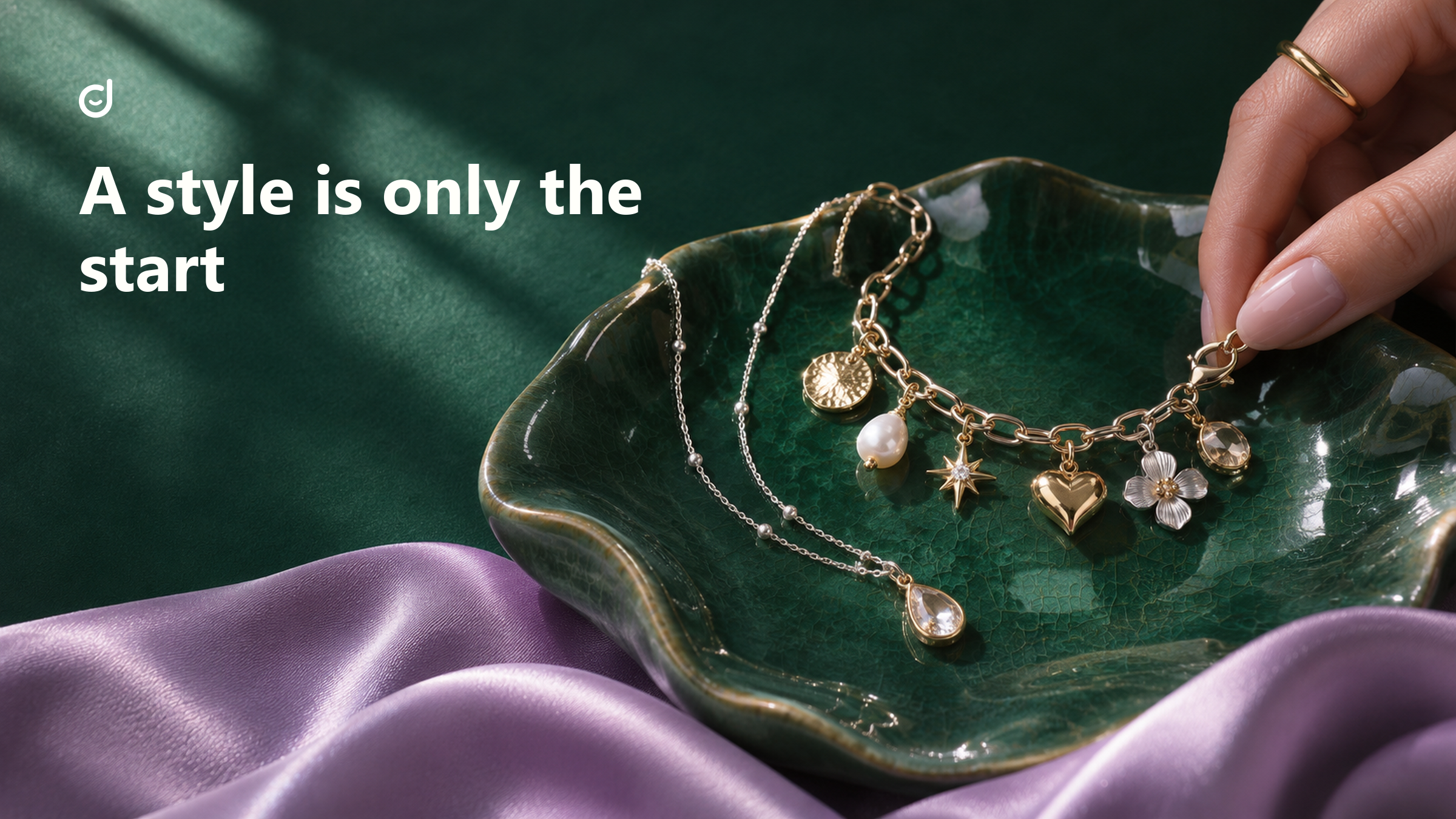
Start with the thing you can describe without a trend label. “A snake-chain bracelet with floral charms” gives you a better research starting point than “viral jewelry.” It names the structure and decoration. You can then compare the clasp, the adjustable range, the way the charms sit and the material description.
Style names can still help you discover ideas. Jewelers Mutual discusses examples such as chokers, large hoops and a revival of Y2K-inspired pieces in its discussion of TikTok and jewelry. Treat these as examples of how styles are discussed, not an independent ranking of today's best-selling items.
Your own feed is also a discovery tool, not a representative market sample. It can show how a piece moves, what clothes it is paired with and the questions a video raises. Save the specific styling question. If a necklace is layered with two others, ask whether the appeal comes from the featured chain alone or from the whole arrangement.
That distinction changes the product you need to inspect. A shopper who wants one easy necklace may not get the same look from a single piece shown in a layered scene. Product content should make that clear. Otherwise, a strong visual idea can create the wrong expectation before the buyer even reaches the listing.
On November 18, 2026, a bounded US jewelry lookup through KOLSprite returned two charm bracelets and a plated necklace. The comparison below retains the listed prices and the provider's explicit seven-day and thirty-day unit fields. It is a dated product observation, not a claim that these are the market's top three items.
| Returned item | Listed price | Reported last 7-day units | Reported last 30-day units |
|---|---|---|---|
| Floral charm bracelet, WANSE | USD 23.40 | 22,080 | 74,003 |
| Initial charm bracelet, WANSE | USD 20.80 | 1,847 | 62,071 |
| Gold-plated necklace, Tewiky | USD 17.99 | 4,649 | 20,548 |
Source: KOLSprite US product lookup, November 18, 2026. These three matches are not the whole market. The unit fields cover different time windows, and the listing titles do not verify their materials.
The two bracelets share a shop, which is a useful piece of context before treating them as separate examples of broad demand. The necklace also serves a different style and wearing job. Combining all three into one average price would erase those differences. Compare a candidate against items that solve a similar style and use question.
Keep the exact product ID beside your notes. A seller may offer several similar titles, and one listing may contain variants. Before comparing two prices, check which size, finish or bundle each price describes. If the returned data does not resolve that choice, open the detail page or ask the supplier rather than assume the items match.
The time windows need care as well. A seven-day total and a thirty-day total are not two equal periods. Their difference is not a growth rate. To investigate momentum, you would need a suitable comparison across equal periods, along with the product's listing and promotion context. Do not turn one table into a forecast of what a new listing will sell.
Open the matched KOLSprite research entry and check current access and supported features; no free-use entitlement is promised.
A video can show a gold-colored finish; it cannot, by appearance alone, establish the metal beneath it. A listing title may use terms such as plated or gold tone. Preserve those terms when taking notes instead of shortening everything to gold jewelry. The shorter label can change what the reader thinks is being sold.
Before buying samples, ask the supplier for the relevant product description and documentation. The exact questions depend on the piece. A chain, a stone setting and an enamel charm create different issues. If an important claim cannot be supported, do not repeat it just because similar words appear in another seller's title.
The FTC's jewelry advertising guidance emphasizes accurate descriptions and material information for buyers. It includes particular guidance for diamonds, gemstones and pearls. Use it as a reason to check the description that applies to your item, not as a shortcut for certifying a product from a search result.
This is also where broad trend copy can go wrong. Words such as waterproof, hypoallergenic or tarnish-free carry more meaning than a style description. They need suitable support. A flattering close-up, a high unit count or a confident creator does not supply that evidence on its own.
The camera may favor a piece that is less convenient to put on. Once you have a sample, inspect the parts the video skipped. For a bracelet, that may mean the clasp, adjustment and how the charms hang. For a necklace, it may be the chain length, the closure and how it sits with an ordinary neckline.
Use realistic context rather than a perfect styling setup alone. A layered photograph can make a small pendant look more prominent than it will on its own. Show a wider view and a detail when you create your own content. If the product is sold as one piece, avoid implying that the whole styled set arrives in the package.
Record what you actually observed. “The clasp was difficult for this tester to close one-handed” is more useful than “bad quality.” It names a task that can be checked again. Likewise, “the pendant turned during this wear test” points to something to investigate without making a broad claim about all units.
Do not treat a quick try-on as proof of long-term durability. Choose any further testing around the claims you plan to make and the item's likely use. A small sample can still reveal a mismatch between the product and your intended customer, even when it cannot answer every question about the material's life.
Join the KOLSprite Discord to discuss the question behind your next research task.
 +
Join the KOLSprite Discord community
KOLSprite's product research can support the comparison stage. Enter a specific product term and market, inspect the returned identities and price fields, and keep each metric's time window attached. The useful output is a shortlist of actual products and questions to check, not a general instruction to stock whatever has the largest number.
The search does not certify a piece's materials, establish your future margin or prove that a creator caused sales. In this lookup, some creator and video fields were missing. Missing information is unknown, not zero activity. Use product details and direct inspection to answer the remaining questions.
Once a candidate is specific, content research gets easier. For the floral bracelet, you might need to see whether the charm arrangement is clear in motion. For an initial bracelet, the buyer may care about choosing and seeing the letter. The necklace may need a useful view of its length. Those are different creative tasks, not three versions of a generic trend montage.
You can develop them with the TikTok video ideas guide. If a spoken description matters, research a video transcript and check the words against the piece being shown. Keep the final content accurate to your own item.
A useful first test has a reason that can be stated in one sentence. For example: “We want to learn whether our customers prefer a floral charm bracelet they can adjust themselves.” This is a hypothetical test question, not a conclusion from the three returned listings. It names a product feature and a customer choice you can investigate.
Keep the first version specific: one piece, a clear material description, a known size range and a content example that shows the actual wearing experience. State what would make you stop, such as an unsupported material claim, a sample that does not match its description or a fit problem for the intended buyer. Set quantities and spending from your own economics rather than borrowing a unit total from another seller.
When you review the result, distinguish attention from purchase and purchase from a satisfactory experience. A comment asking for the price is not a completed order. A sale does not tell you whether the buyer received the look they expected. Choose the evidence that fits the decision you are making next.
A good product story makes that expectation easier to understand. Show the detail that matters to the buyer and use the description the item can support. The style can attract the first look; the product has to carry the rest.
TikTok jewelry trends are useful leads when they help you ask better product questions. Move from the style name to a comparable item, from the item to a sample, and from the sample to a clear test. That is a more defensible buying path than treating a fashionable word or a large reported number as a reason to order stock.
Latest Articles

As an essential, data-driven toolkit for TikTok influencers and marketers, KOLSprite provides powerful features for effortless creator discovery, trending content identification, and actionable real-time insights.
It empowers users to make smarter decisions and significantly boosts their TikTok business.

 Refer & Earn