 +
+
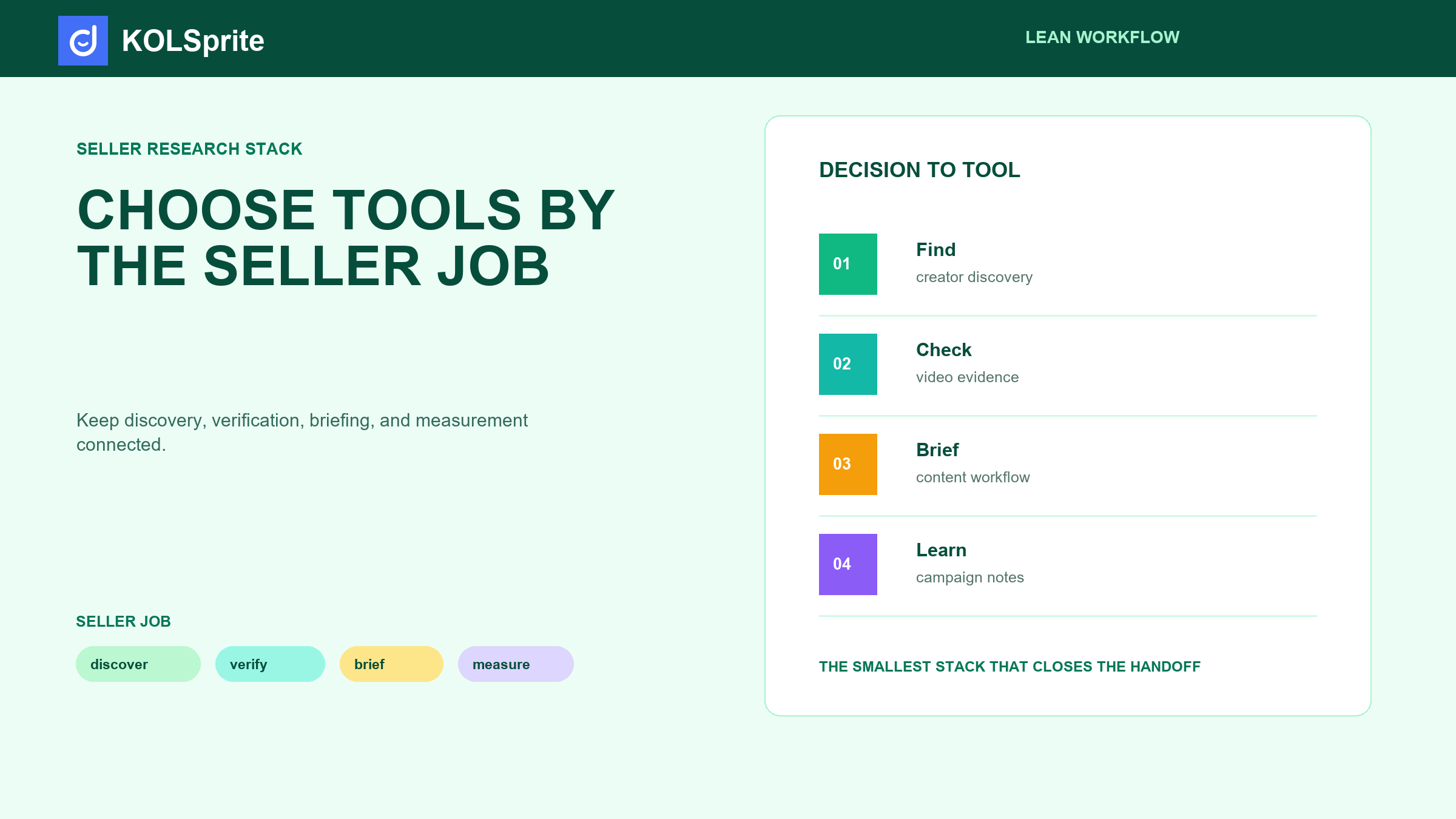
For sellers and content teams, TikTok creator tools is useful only when it helps make a real choice. This guide shows how to use tool selection around a creator research stack without overstating the data. The direct answer is simple: the leanest stack is not the one with the fewest tabs; it is the one that leaves fewer important questions unanswered. By the end, you will have a decision-to-tool map that can guide the next brief, test, or stop decision.
The point of view: Choose creator tools by the decision that is stuck. The risk is buying separate tools that create handoffs instead of resolving decisions.
Write down the choices your team repeats: which creator to contact, which video proof matters, which product angle to test, and whether to reinvite. A tool earns its place when it makes one of those choices faster or more defensible.
For the creator research stack question, write one line naming the buyer job, visible proof, and claim limit. Keep that line beside the decision-to-tool map so the brief stays tied to a real use case.
Do not promote the tool selection phrase into product copy until the creator research stack shows the promised action in the buyer setting: a shortlist review, a content check, and an outreach handoff.
A broad creator search can create a useful list. It cannot replace watching the relevant posts or checking the product scenario. Put discovery and check in different columns so a large audience number does not accidentally become a fit decision.
Test the idea in a shortlist review, a content check, and an outreach handoff. Ask what a colleague would need to see before accepting it, then turn that answer into one check inside the decision-to-tool map.
If the creator research stack example works only in a polished setup, mark that limit. The decision-to-tool map must survive a normal buyer condition, not only a perfect demo.KOLSPRITE_TRIAL_CTA
Try the tool selection workflow with a real decision.
New KOLSprite users can claim a three-day trial membership to compare the product, creator, and video evidence behind one creator research stack question.
Start your three-day trial
If one person exports a list while another person rechecks the same videos in a different system, the stack has a handoff problem. Choose a workflow where the source, filters, notes, and next action stay connected as long as possible.
At the tool selection handoff, attach the source and next owner. That keeps remove duplicate data work open to a later check instead of turning it into a takeaway nobody can revisit.
Keep the original wording beside the decision-to-tool map. That lets the team separate what was observed, what was inferred, and what still needs a test.
Monday: define the product question. Midweek: review sources and shortlist. Friday: turn the results into a brief, a sample decision, or a stop decision. A simple rhythm keeps a tool from becoming a dashboard nobody uses.
If the creator research stack result is weak, record the missing proof, fit, offer, or cost beside the decision-to-tool map. A precise failure note prevents the next browse from repeating the same mistake.
A weak tool selection result can still teach the owner what to change. Record the missing creator research stack fact instead of smoothing it over with a stronger headline.
| tool selection field | What to record | Decision it supports |
|---|---|---|
| Observed signal | a public creator result can show a follower count while leaving fit, turnaround, pricing, and content constraints unanswered | Whether the creator research stack example deserves closer review |
| Proof need | One visible action in a shortlist review, a content check, and an outreach handoff | What the next brief must demonstrate for this use case |
| Known limit | buying separate tools that create handoffs instead of resolving decisions | What the team must check outside public platform data |
| Next action | a decision-to-tool map | A named test, hold, or handoff for this decision |
Tool Selection source note: KOLSprite MCP public US-market snapshot for the creator research stack, accessed August 7, 2026. This example shows how to use a decision-to-tool map; it does not estimate the whole category.KOLSPRITE_DISCORD_CTA
Build a seller research stack around decisions, not around the number of tools. One tool should help you find a signal, another should help you verify the creator or content, and a final record should explain what the team will do next. If two tools produce the same evidence, keep the one that is faster to revisit.
A strong weekly rhythm can be simple: collect a small set of examples, remove weak or duplicated signals, compare creator fit, and turn the best finding into one testable brief. This keeps research close to execution and makes it easier to learn from results.
KOLSprite fills the gap between browsing and documentation. It lets a team save the source, inspect the surrounding creator and video context, and carry a clear reason into the next product or content decision.
A creator tool should remove a stuck decision, not add another dashboard to review. Before you share the tool decision map, mark what was observed, what was inferred, and what still needs a check.
The stack owner should leave one decision, one useful output, and one handoff that proves the tool earned its place.
When a workflow changes, revise the tool map and keep the old handoff visible for a fair comparison.
Close the tool map by naming the stuck decision, the tool that resolves it, the output expected, and the handoff that follows. Save the tool output beside the decision and let the next stack review decide whether the workflow deserves another seat.
Want a second set of eyes on the decision-to-tool map?
 +
+
Join the KOLSprite Discord community
A useful adoption signal is whether a creator record arrives at outreach with a clear reason, risk, and next action. Seat count and time in a tool are weaker signals if the campaign still relies on guesswork.
Keep the detail that changes the next tool selection brief. The decision-to-tool map should make the creator research stack choice easier to defend, not summarize every signal in the category.
Use the decision-to-tool map to choose one next clip, creator, listing change, or sample check. More examples are not better when the creator research stack decision stays open.
KOLSprite is most useful for seller teams that need to research creators and product-linked content without treating them as separate projects. Use the browser extension during TikTok browsing and the web platform when the work requires focused search, comparison, or follow-up.
Finish where kolsprite fits by naming test, hold, compare, or stop. KOLSprite can keep the creator research stack source and creator context near that choice for the next owner.
This stack audit is complete when another owner can explain the creator research stack choice and repeat the check without asking for hidden context.
Do not add a tool because it has a new panel. Add it when a real choice is slow or weak. If no one uses the output in a brief, remove the step. Ask three plain questions. Who uses this? What do they get? What do they do next? A tool that cannot answer those questions does not earn a place in the stack.
For tool selection work on a creator research stack, keep the buyer job intact when the format changes. The TikTok creator tools question decides whether this source becomes an Amazon brief, a Shopify page test, or a creator request.
Start the creator research stack handoff with the scene that makes the need obvious: a shortlist review, a content check, and an outreach handoff. For a tool selection review, ask which action earns belief and which product limit must appear before the viewer accepts the claim.
Give the decision-to-tool map its own source, signal, proof, limit, and next-action fields. In a tool selection handoff, that small record shows why the example matters without sending the next owner back through a folder of screenshots.
In this stack audit, compare the tool selection example with a shortlist review, a content check, and an outreach handoff. A high-play result is not enough when buying separate tools that create handoffs instead of resolving decisions. Record the proof gap, creator fit, and next choice in the decision-to-tool map.
Run the smallest tool selection test that can change the choice. For this tool selection work, expand a supported hypothesis, record a failed one, and move on when the creator research stack evidence stays weak.
A useful TikTok creator tools process ends with one concrete commitment: who will run the next tool selection check, which creator research stack condition they will review, and what result would alter the plan. Keep the source beside the takeaway for a decision-to-tool map, then decide whether the next move is a test, a hold, or a request for better evidence.
For a related next step, use creator research, compare it with content check, and move the resulting decision into creator analytics. For the platform-level boundary relevant to this stack audit, see TikTok creator resources.
Latest Articles
As an essential, data-driven toolkit for TikTok influencers and marketers, KOLSprite provides powerful features for effortless creator discovery, trending content identification, and actionable real-time insights.
It empowers users to make smarter decisions and significantly boosts their TikTok business.
 Refer & Earn