 +
+
TikTok creator marketplace is for TikTok Shop and Shopify seller teams who need to choose creators who can demonstrate a kitchen organizer without relying on follower count alone. The short answer is to begin with a decision, keep only evidence that can change it, and write down the limit beside the signal. This creator selection field guide gives you a four-part creator shortlist and outreach-ready notes. It is built for a busy seller who needs a next move, not another collection of screenshots.
A creator is not a media slot. The decision is whether this person can make the buyer trust the product in a real setting. Start with one question. Collect a small, checkable set of records. Then end the session with a test, a contact, a hold, or a reject. That is the difference between scrolling and research.
Most teams begin with a broad category and see a mix of entertaining clips, old offers, adjacent products, and creators with different jobs. The material looks abundant. So it is tempting to call it proof. It is not. The useful question is narrower: what evidence would make us act differently on this exact product, creator, or message?
Watch the last five relevant posts before you compare any profile total. This small move changes the whole session. It tells the reviewer which observations deserve a note and which ones should stay in the feed. It also makes a later meeting less dependent on who remembers the most viral clip.
A kitchen-organizer search returned product-linked videos from small creators as well as broad lifestyle accounts. The useful distinction was not fame. It was whether the clip showed a real drawer, the adjustable fit, and the before-and-after result.
One returned 22-second organizer video had 4.2 million visible plays and a product record with 2,061 recent units. That is a strong reason to inspect the format, not a reason to assume another creator will repeat its result.
| Observed | Reasonable use | What it cannot answer |
|---|---|---|
| Public video or product record | Identify a buyer job and a visible proof format. | Profit, private conversion, rights, or future demand. |
| Creator and category context | Decide whether a closer fit review is worthwhile. | Audience truth, reliability, price, or contract terms. |
| Visible response and sales fields | Prioritize a question for a small test. | What caused the outcome or whether it will repeat. |
Source note: scoped KOLSprite MCP public US-market result, reviewed August 7, 2026. This is a worked illustration. It is not a market census or a recommendation to buy, hire, or reuse any specific item.
Use four lines. First, record the source and date. Second, state one observed fact in plain language. Third, name the missing input. Fourth, assign the next action and owner. This is deliberately smaller than a research deck. A compact note is easier to challenge, reuse, and improve.
Decision: choose creators who can demonstrate a kitchen organizer without relying on follower count alone
Observed: home organization and drawer fit appear in the source context.
Missing: a product-specific test, commercial input, or rights check.
Next move: run one limited test before spending more budget.
Do not hide the missing line. A source becomes more valuable when the next reader can see where confidence ends. The best teams do not confuse a careful limit with a weak conclusion.
KOLSprite keeps product, creator, and video research close to the decision that follows. New users can register for a three-day trial membership.
Register for a three-day KOLSprite trial
Failing one check does not mean the source is worthless. It means the next action should be smaller. That might be a sample, a product test, a creator watchlist, or a revised brief rather than an inventory order.
Use creator search workspace when you need to locate the relevant entity, then use product-linked video search and creator engagement benchmarks only for the next connected task. KOLSprite is valuable here because it keeps public TikTok evidence in a working sequence. It does not supply a margin model, make a claim legal, or replace a product test. Those boundaries are part of the workflow, not a footnote.
The practical outcome is a shorter path from a signal to a decision. You can move from an observed video to a creator review, a product comparison, or a content brief without turning a number into a promise.
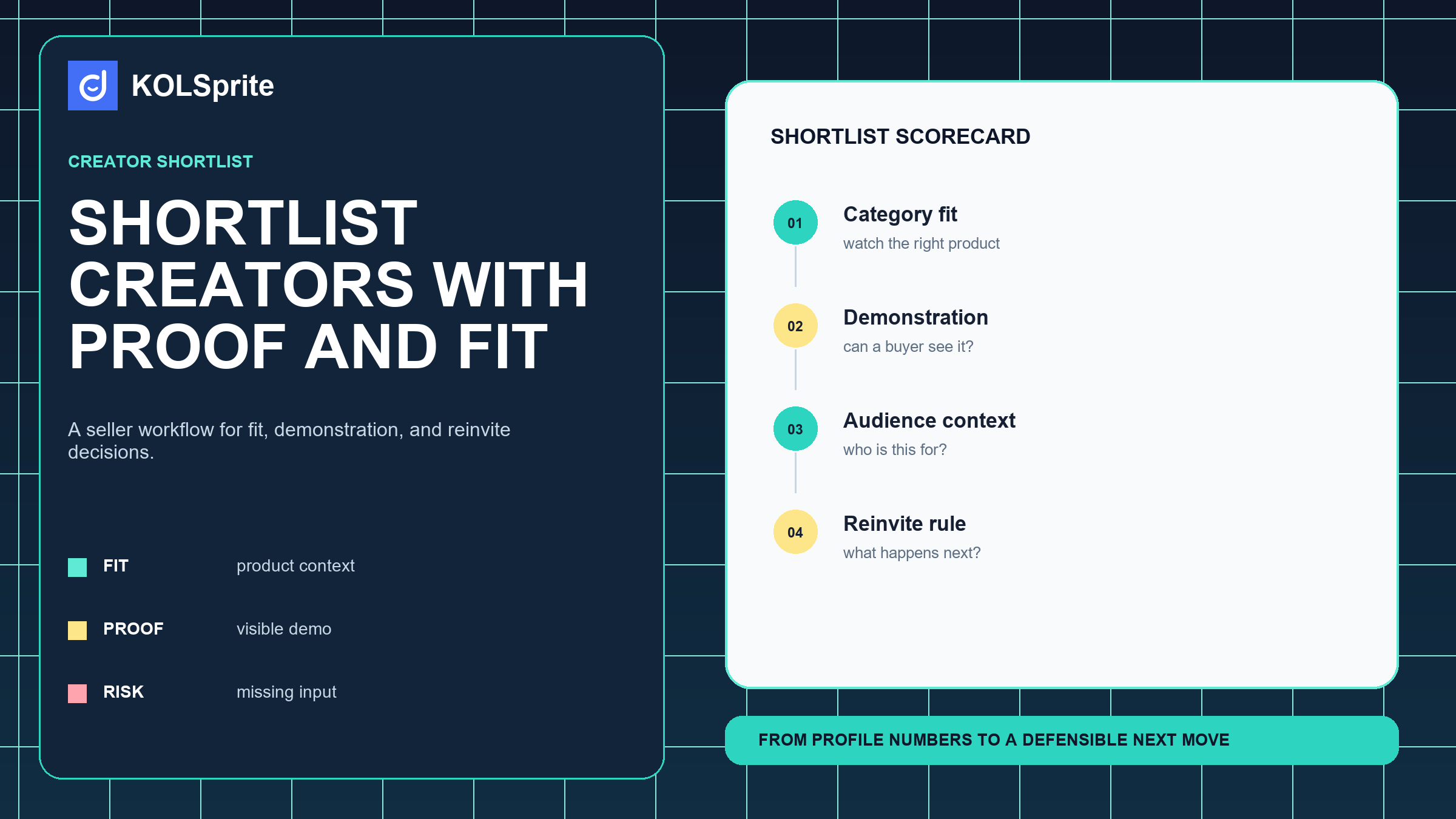
For each creator, write one sentence that answers a specific question: why would this person make the organizer believable to the buyer we want? “Good engagement” is not an answer. “Their recent home-reset videos show real drawers, tight storage spaces, and a calm step-by-step camera style” is an answer. It gives the next reviewer something concrete to watch for.
Then write the risk beside the reason. A creator can be excellent at organizing a pantry and still be a weak choice for a narrow drawer product. They may use a room that is much larger than the customer’s room. They may show a product once but never explain fit. They may speak to a broad lifestyle audience when the campaign needs a practical shopping decision. The risk note is not a rejection. It tells the team what a sample brief must prove.
First, watch one post that is close to your category. Look for the camera angle, the speed of the explanation, and the point where the product becomes useful. Second, watch a post outside the category. This helps you see whether the creator has a repeatable way of showing a problem, or simply had one lucky product match. Third, read the most relevant public context available to you. You are looking for a buyer situation, not for a perfect demographic label.
This is where many marketplace shortlists become inflated. A profile can have a large number beside it, a polished feed, and a familiar aesthetic. None of those details proves that the person can answer the practical question a buyer will have before checkout. The organizer case is simple: does the content show the drawer, the adjustment, the actual items, and the finished result? If the camera skips the constraint, the creative may look pleasant while failing to remove doubt.
Share the public signal, the limit you recorded, and the next action. Leave private campaign information out of the post.
 +
+
Join the KOLSprite Discord community
When a platform definition or rule affects the work, verify it with TikTok Creative Center. That source can clarify the boundary. It cannot make the business decision for you. Keep the public evidence, your product test, and your operating data separate so the final conclusion stays honest.
For the next cycle, use the completed handoff as the starting point. Review what changed, what remained unknown, and whether the first action produced a useful answer. That is how the process gains depth without becoming a larger spreadsheet.
A strong TikTok creator marketplace process has one job: turn a fast public signal into a careful next move. Keep the source. State the observation. Write the limit. Give the action an owner. Your team will make fewer dramatic claims, and better decisions.
A first message should show that the team has done the basic work. Name the product category, the buyer situation, and the kind of demonstration you are considering. Do not send a full script. Ask one small question that helps you judge fit. For example: “We are testing an adjustable drawer organizer for small kitchens. Would a real before-and-after drawer setup fit your content style?” The question is clear, respectful, and gives the creator room to say no.
When a creator replies, do not immediately promote them to the whole program. Check whether their answer adds information. A useful reply may describe the space they could use, the product concern they would want to test, or the way their audience shops. A vague reply is not a moral failure. It is simply a reason to keep the next step small. Send one sample, agree on the proof requirement, and make the review point visible before the video is made.
After the first collaboration, compare the work against the original reason for the shortlist. Did the creator show the fit? Did the content make the product understandable? Did the handoff arrive on time? Did the team learn something that improves the next brief? A high-reach post can be valuable. But it is not the only reason to reinvite. A smaller creator who reveals a strong buyer objection may be the better long-term partner.
Keep a reinvite field in the same card. Use one of four labels: repeat with the same proof, test a new proof, hold for a different category, or close the thread. This is more useful than a generic star rating. It gives a future teammate enough context to understand why the relationship moved forward or stopped.
Latest Articles
As an essential, data-driven toolkit for TikTok influencers and marketers, KOLSprite provides powerful features for effortless creator discovery, trending content identification, and actionable real-time insights.
It empowers users to make smarter decisions and significantly boosts their TikTok business.

 Refer & Earn