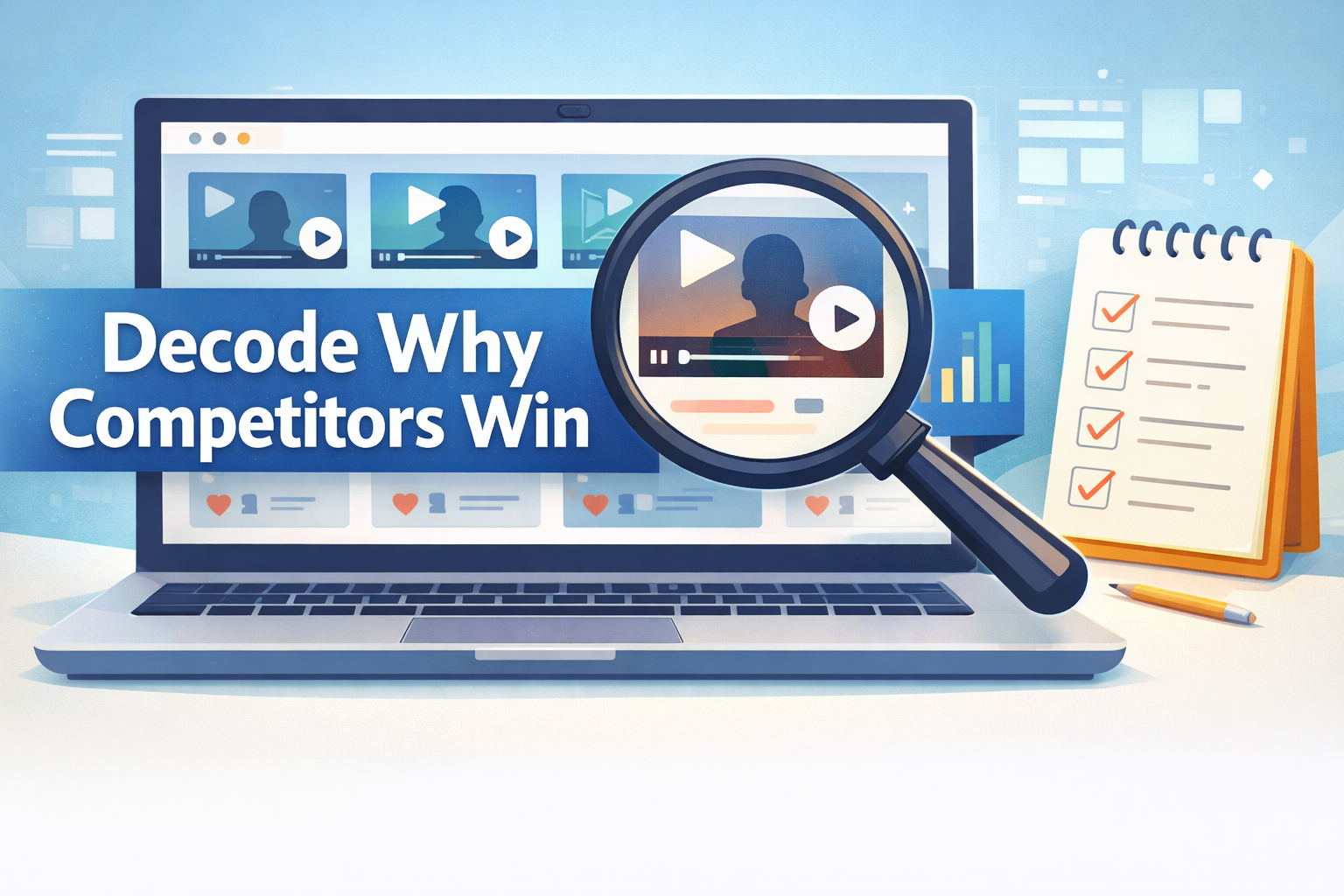
This article is written for TikTok beginners who notice competitors with low video quality but strong sales or engagement. It explains how to use KOLSprite’s video download, competitor account analysis, and comment insights to understand why those videos work — without copying blindly.
 +
+
Intro — “Why does their terrible video outperform mine?”
Almost every TikTok beginner hits this moment.
You spend time editing.
You add captions.
You clean up the lighting.
Then you scroll — and see a competitor:
- Shaky camera
- Messy background
- Zero aesthetics
Yet their video:
- Gets 100K+ views
- Has comments asking “where to buy?”
- Actually sells
This isn’t bad luck.
It’s a misunderstanding of what TikTok rewards.
Section 1 — TikTok doesn’t judge quality the way humans do
Humans evaluate videos emotionally and visually.
TikTok evaluates videos behaviorally.
The platform looks at:
- How fast people stop scrolling
- Whether they watch until the end
- If they interact (especially comments & saves)
A video can look “bad” but still:
- Hit a strong pain point
- Show the product instantly
- Trigger curiosity in the first 2 seconds
And that’s often enough.
Section 2 — Why beginners misread competitor success
Beginners usually focus on:
- Camera quality
- Editing style
- Visual cleanliness
But competitors who win often focus on:
- Speed (how fast the point appears)
- Clarity (problem → product → result)
- Familiar formats (things viewers already understand)
When you don’t analyze this systematically, it feels random.
Section 3 — What you should actually study in a competitor video
When experienced sellers look at a competitor’s video, they don’t ask:
“Is this video good?”
They ask:
- When does the hook happen?
- How fast does the product appear?
- What are people asking in the comments?
This requires slowing the video down and looking at patterns — not impressions.
That’s why many beginners eventually start downloading competitor videos and reviewing them frame by frame, instead of watching passively.
Section 4 — Turning confusion into analysis (how beginners do it)
A common beginner workflow looks like this:
- Save several competitor videos that “shouldn’t work” but do
- Watch them repeatedly
- Try to identify:
- First visual trigger
- First text overlay
- First moment of payoff
At this stage, many people still feel stuck — because memory isn’t analysis.
This is where tools that show actual performance data start to matter.
Section 5 — How KOLSprite fits naturally into this process
At some point, beginners want to answer questions like:
- Is this video a one-off or part of a pattern?
- Do multiple low-quality videos from this account perform well?
- Are people actually showing buying intent, or just reacting?
KOLSprite helps at this exact moment by letting users:
- Download competitor videos cleanly for closer inspection
- Compare engagement ratios across multiple videos
- Observe comment patterns across an entire account
This turns “that video feels lucky” into “this creator uses the same structure repeatedly”.
Section 6 — The role of comments (where sales signals hide)
One major difference between viral-but-useless videos and selling videos is the comment section.
Selling videos tend to have:
- Repeated questions (“does this work for…?”)
- Price curiosity
- Usage scenarios
By scanning comments across similar videos, patterns emerge:
- Same objections
- Same misunderstandings
- Same motivations
These insights are more valuable than view counts.
Section 7 — What to copy, and what to leave behind
Ethical, effective learning means:
- Copying logic, not footage
- Copying timing, not scripts
- Copying angle, not personality
A beginner-friendly rule:
If you can explain why a part works, you’re allowed to reuse the idea.
If you can’t explain it, don’t touch it.
Section 8 — Why this approach scales better than guessing
Random posting leads to:
- Emotional burnout
- Inconsistent results
- Algorithm paranoia
Structured observation leads to:
- Faster improvement
- Fewer failed posts
- Clear learning loops
Most successful TikTok sellers didn’t start with great videos — they started with good observation habits.
Final Thoughts
Your competitor isn’t winning because their video is ugly.
They’re winning because:
- Their structure is clear
- Their hook is fast
- Their content matches how people scroll
Once you stop judging videos by appearance and start studying behavior, TikTok becomes far less mysterious.
CTA
Instead of guessing why competitors win, study the structure behind their videos. Tools like KOLSprite help beginners see patterns faster — without copying blindly.

 Refer & Earn